
Most microcurrent facial devices need a compatible water-based conductive medium because dry skin creates electrical resistance and uneven electrode contact. Use the product specified by your device—being wet or slippery does not automatically make a serum, oil, or aloe gel a suitable substitute.
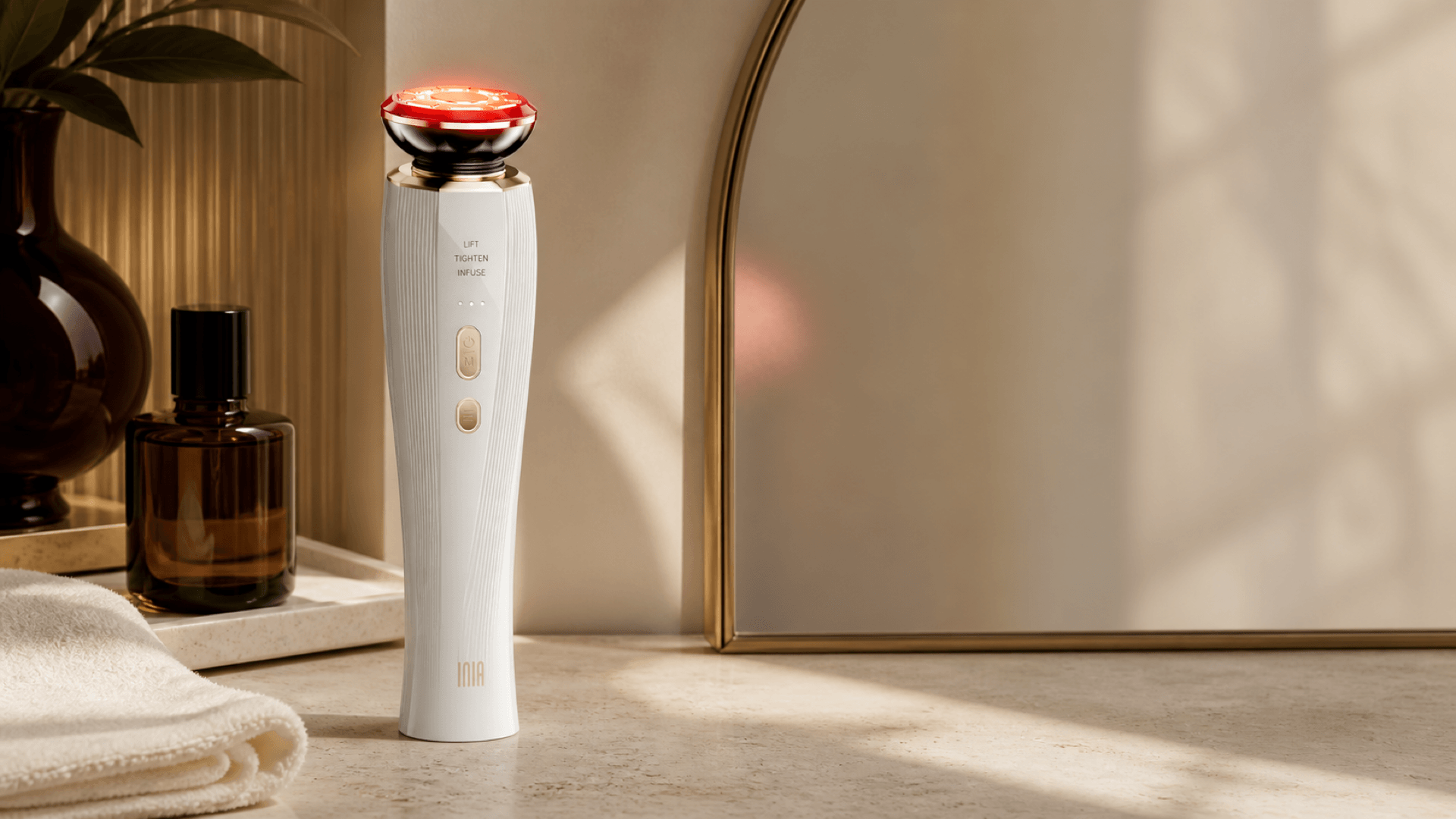
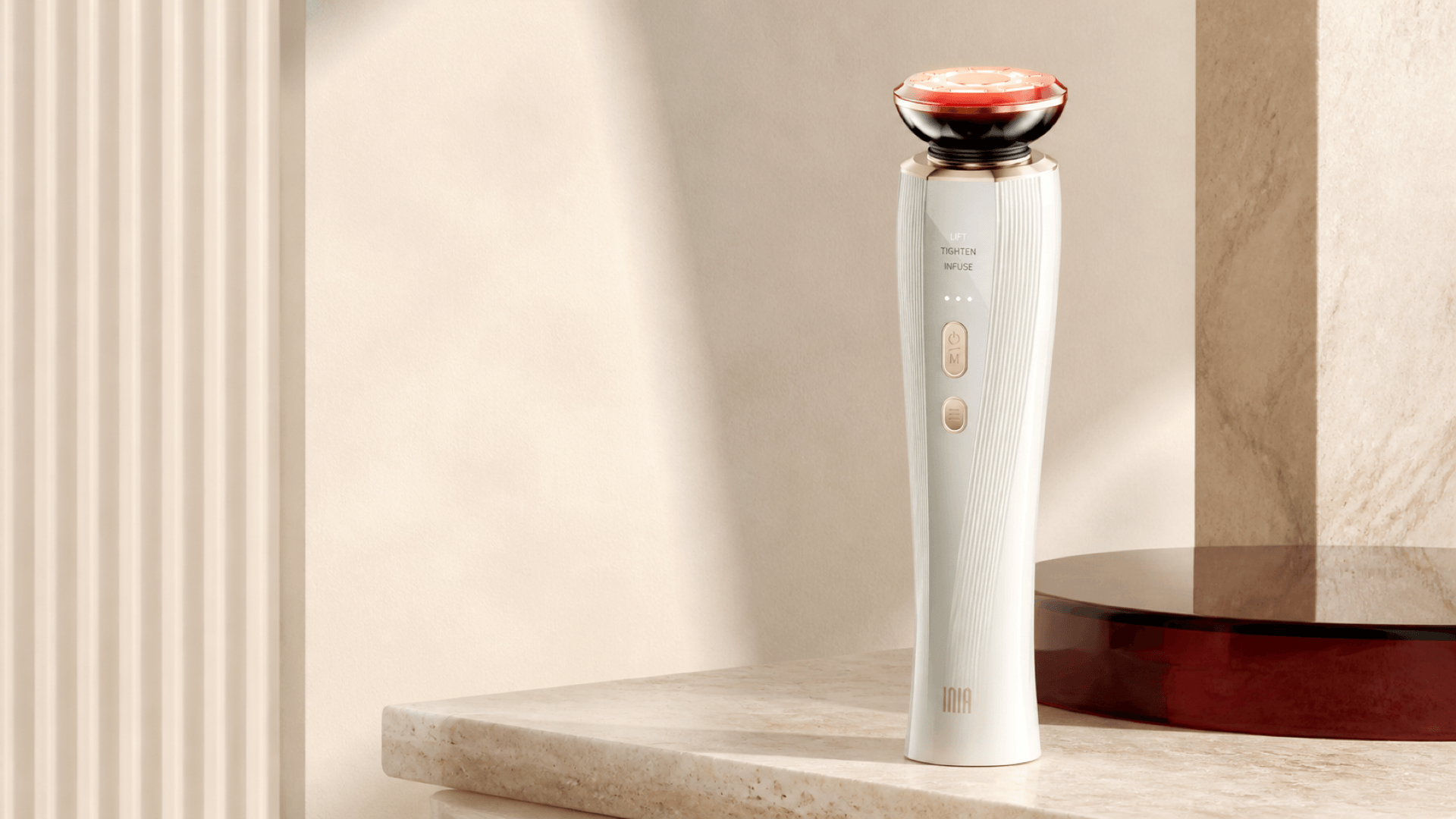
With INIA FLARE, apply enough conductive gel for LIFT and TIGHTEN, and use a water-based serum or essence only with INFUSE. Do not use it over makeup, thick oils, heavy creams, or clay masks. If you are new to microcurrent or have sensitive skin, start at Level 1 and complete a patch test first.
Table of Contents
Why Does a Microcurrent Device Need a Conductive Medium?
The reason begins at the skin's outer layer. Reviews of skin bioimpedance identify the stratum corneum as a major source of skin impedance and explain that its hydration changes electrical measurements.1,2 In practical terms, a hydrated interface provides more conductive pathways than a dry, incomplete skin–electrode contact.
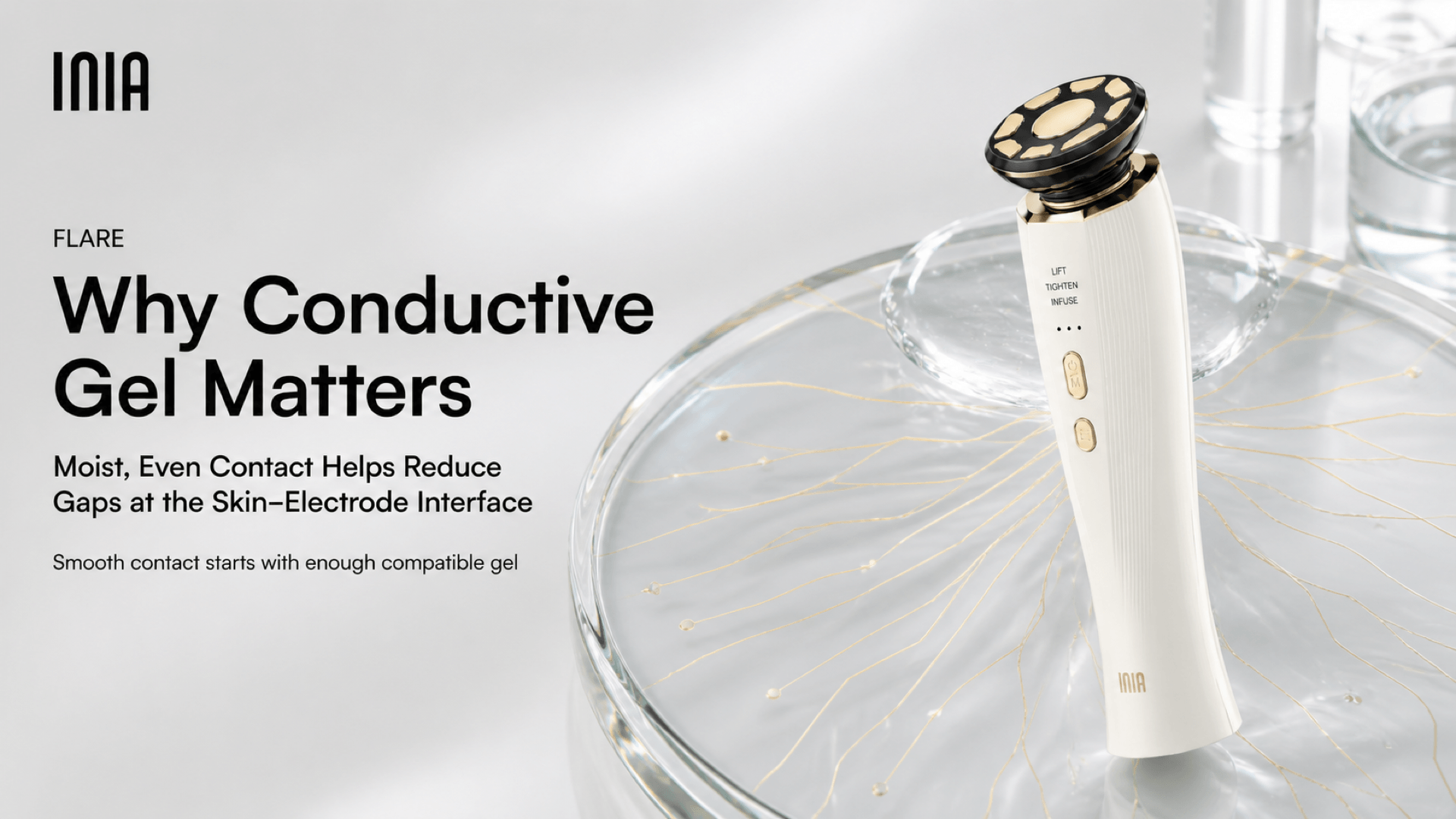
A conductive gel is therefore more than a glide product. It helps keep the contact area moist and reduces gaps between the electrode and the skin. An FDA 510(k) summary for an electrotherapy conductive gel says the product is used with external electrodes to reduce contact impedance and describes even application so current is distributed across the contact area.3
Wet products are not automatically interchangeable. A study comparing four electrode gels found measurable differences in moisture behavior and electrical responses between formulations.4 Water content matters, but so do the full formula, how long it stays wet, skin compatibility, and the device's requirements.
These sources support general skin–electrode interface mechanics. They do not prove that one cosmetic gel creates better facial results, and the FDA record concerns TENS and EMS conductive media—not FLARE or cosmetic microcurrent outcomes. Specific compatibility must still come from the device instructions.
Conductive Gel, Serum, or Substitute: How to Choose
Begin with the mode you plan to use, not with the product already on your bathroom shelf. Ask two questions: does this mode require electrical contact, and does the current manufacturer guidance explicitly permit this product type?
On mobile, swipe left within the table to compare every column.
| Product type | What to verify first | When it may fit |
|---|---|---|
| Conductive gel | The device instructions identify it as compatible, and enough remains on the skin for smooth, flat contact | Electrical-contact modes when required by the device |
| Water-based serum or essence | The device instructions explicitly allow it for the selected mode | A skincare-application or infusion mode designed for it |
| Aloe gel | “Aloe” and “water-based” alone do not establish electrical compatibility | Only when the device manufacturer permits that product type |
| Ultrasound gel | Acoustic coupling and electrical-device compatibility are not automatically the same requirement | Only when the microcurrent-device manufacturer permits it |
| Facial oil or petrolatum | Slip does not establish conductivity; FLARE excludes thick oils | Not underneath FLARE's specified electrical-contact modes |
| Heavy cream or clay mask | FLARE guidance excludes both product types during use | Not underneath FLARE modes |
Can a water-based serum replace conductive gel?
Only when the device instructions allow it for the active mode. “Water-based” is a formulation description, not universal approval for electrical contact. With FLARE, use conductive gel for LIFT and TIGHTEN; reserve a water-based serum or essence for INFUSE.
Can aloe vera gel work with microcurrent?
Do not treat aloe gel as a universal substitute. Aloe formulas vary in thickeners, fragrance, alcohol, preservatives, and how they behave on the skin. Use one only if the current instructions for your exact device permit it.
What about ultrasound gel?
Ultrasound gel is designed to remove air at a skin–transducer interface for acoustic coupling. That purpose does not automatically confirm compatibility with an electrical facial device. Do not use it with FLARE unless current INIA guidance explicitly identifies it as compatible.
Why not use facial oil or Vaseline?
Slipperiness is not the same as a suitable electrical interface. FLARE should not be used over thick oils or heavy creams, and LIFT and TIGHTEN specifically require conductive gel. Apply oil-based skincare later in the routine if it otherwise suits your skin.
How INIA FLARE Separates Gel From Serum
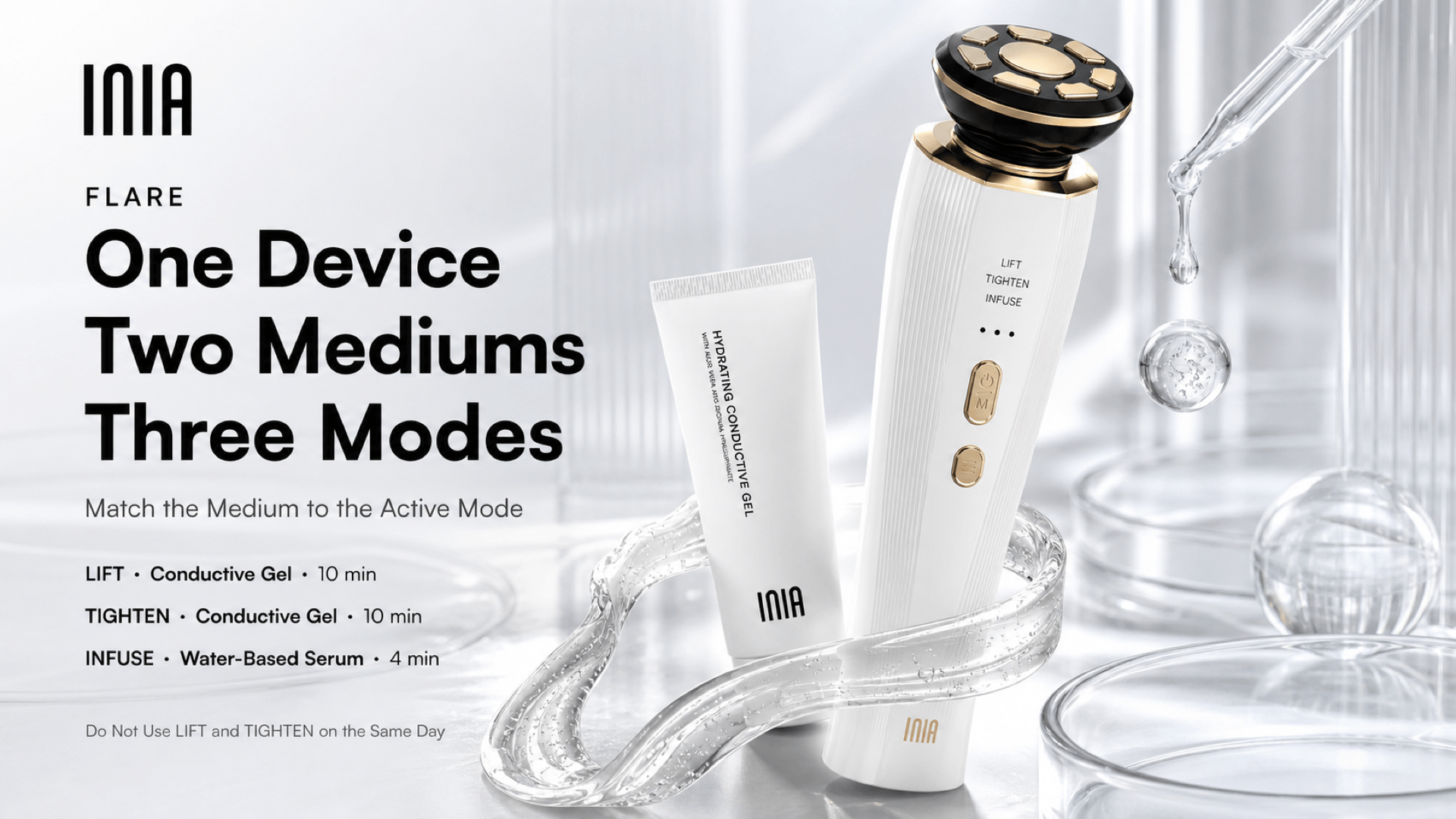
Conductive gel and skincare serum do different jobs. INIA FLARE builds that distinction into three modes, so users do not have to guess whether one everyday serum is “conductive enough” for the entire routine.
On mobile, swipe left within the table to see the full session guidance.
| FLARE mode | What to apply | Session guidance |
|---|---|---|
| LIFT | Enough conductive gel | 10 minutes; 3–4 times per week |
| TIGHTEN | Enough conductive gel | 10 minutes; 3–4 times per week; not on the same day as LIFT |
| INFUSE | Water-based serum or essence | 4 minutes; may be used daily if tolerated |
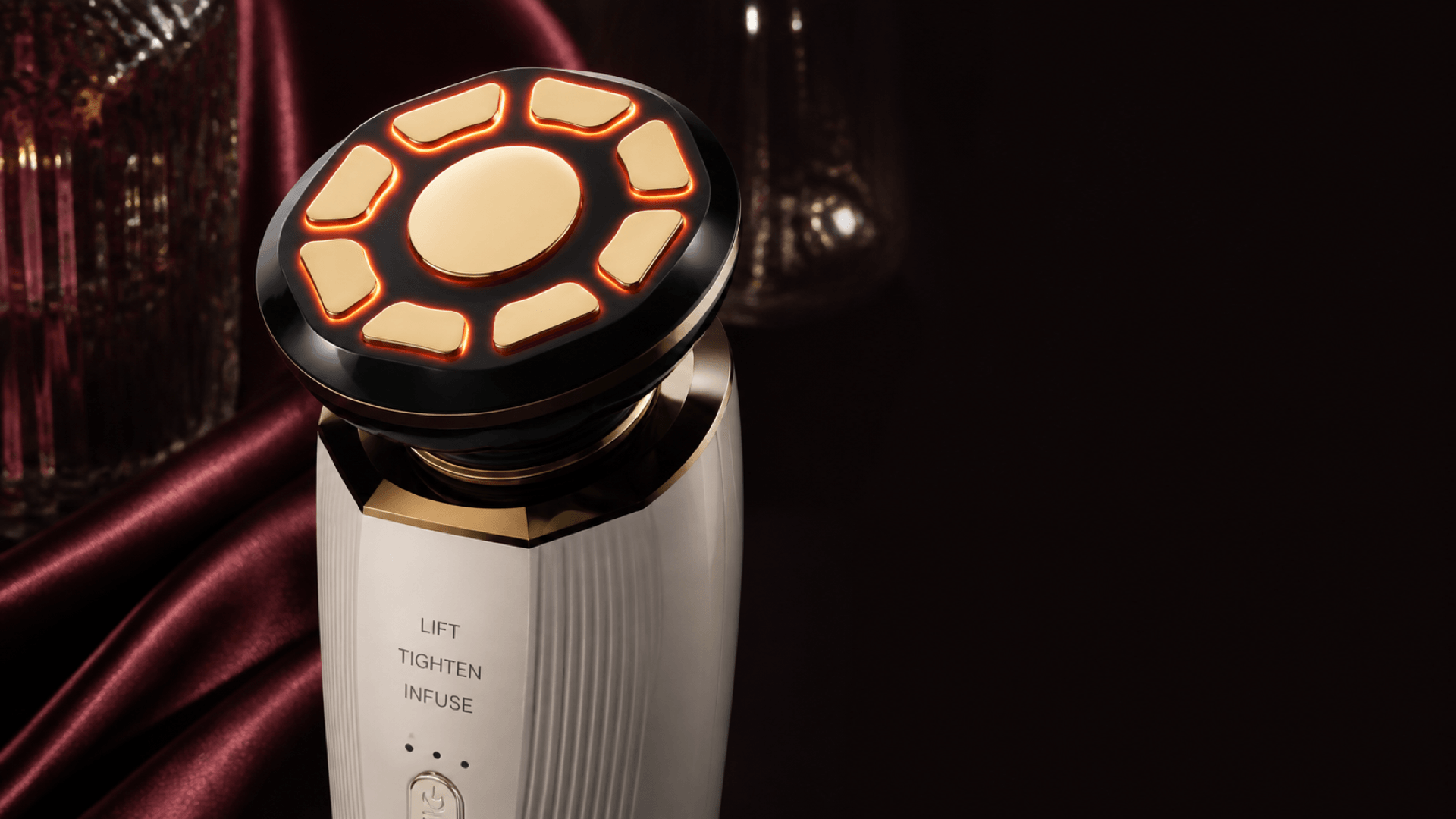
FLARE also addresses contact through its physical controls. Its 10-degree movable head helps maintain contact along facial curves, while the hand must touch the side handle electrodes to close the circuit. Three intensity levels let a new or sensitive-skin user start at Level 1 instead of trying to compensate for poor contact by immediately increasing intensity.
How to Use Conductive Gel With FLARE
- Clean and dry the skin. Remove makeup, oil, and other residue.
- Apply enough conductive gel. Cover the area you plan to use with LIFT or TIGHTEN. Add more if the layer becomes too thin for smooth contact.
- Hold the side electrodes. Keep your hand touching the conductive areas on the handle so the circuit remains closed.
- Start at Level 1. Select either LIFT or TIGHTEN; do not use both on the same day.
- Keep the head flat. Glide upward and outward along facial contours without pressing hard.
- Complete the 10-minute routine. Use about four minutes on each cheek and two minutes on the forehead.
- Remove the gel. Rinse with lukewarm water, then continue with normal skincare.
For INFUSE, apply a water-based serum or essence instead of conductive gel. Use the mode for four minutes and allow the remaining skincare to absorb; do not rinse it away.
Troubleshooting Tingling, Dragging, or No Sensation
The device feels prickly or uneven
Pause and check the interface before increasing intensity. Apply enough conductive gel, keep the head flat, and move slowly. Mild tingling can occur, but stop if you experience pain, burning, blistering, or persistent irritation.
The head drags across the skin
The gel layer may be too thin. Add enough gel to restore smooth contact instead of pressing harder or forcing a dry electrode across the skin.
You cannot feel the microcurrent
Sensation alone is not a measure of results. For FLARE, first check whether there is enough gel, the head is flat, your hand is touching the side electrodes, and you are moving slowly enough. After correcting contact, confirm that the selected intensity is appropriate.
Patch Testing and Safety Boundaries
For a first-use sensitivity test, clean and dry the inner arm, apply a thin layer of conductive gel, and use LIFT at Level 1 for three to five minutes. Remove the gel and monitor the area for at least six hours. Stop use if redness, swelling, itching, burning, or another abnormal reaction occurs.
Do not use FLARE if you are pregnant, planning pregnancy, or breastfeeding, or if you have a pacemaker, defibrillator, insulin pump, nerve stimulator, or another active implanted electronic device. Avoid open wounds, active rashes, inflamed skin, the thyroid area, chest, eyeballs, and upper eyelids, and follow the complete current safety instructions before use.5
Choose the Mode First, Then the Medium
The best product for a microcurrent routine is not simply the wettest or slipperiest option. Use the conductive medium specified for the active device mode and do not assume that an ordinary serum, aloe gel, ultrasound gel, oil, or cream is an electrical substitute.
With FLARE, the choice is direct: conductive gel for LIFT and TIGHTEN, and water-based serum or essence for INFUSE. The three-mode routine separates electrical contact from skincare application, so each product has one clear job.
Frequently Asked Questions
Do you need conductive gel for a microcurrent device?
Many microcurrent devices require a compatible conductive medium, but the exact product depends on the manufacturer and mode. FLARE requires conductive gel for LIFT and TIGHTEN.
What gel should I use with a microcurrent facial device?
Use a water-based conductive gel identified as compatible with your exact device and selected mode. Do not choose only by texture or assume every skincare gel has equivalent electrical properties.
Can I use a serum with a microcurrent device?
Only when the device instructions permit it for the active mode. FLARE uses a water-based serum or essence with INFUSE, not as the specified replacement for conductive gel in LIFT or TIGHTEN.
Can I use a microcurrent device without gel?
Do not use an electrical mode dry when its instructions require conductive gel. Dry or incomplete contact increases interface impedance and can make contact and sensation less consistent.
Is aloe vera gel a conductive gel?
An aloe gel may contain a large amount of water, but that alone does not establish compatibility with a specific microcurrent device. Formulas vary, so follow the current device instructions.
Is ultrasound gel the same as microcurrent conductive gel?
Not automatically. Ultrasound gel is intended primarily for acoustic coupling. Use it with a microcurrent device only if that device's manufacturer identifies it as compatible.
Can I use oil with FLARE?
Do not use FLARE over thick oils. Apply conductive gel for LIFT and TIGHTEN, and use a water-based serum or essence for INFUSE.
Why does FLARE feel stronger in some areas?
Gel thickness, facial contours, electrode contact, skin condition, and movement speed can affect sensation. Keep the head flat, maintain enough gel, move slowly, and begin at Level 1.
References
- Lu F, et al. Review of Stratum Corneum Impedance Measurement in Non-Invasive Penetration Application. Biosensors. 2018.
- Gidado IM, Qassem M, Triantis IF, Kyriacou PA. Review of Advances in the Measurement of Skin Hydration Based on Sensing of Optical and Electrical Tissue Properties. Sensors. 2022.
- U.S. Food and Drug Administration. 510(k) Summary K222770: Conductive Gel. 2022.
- Tronstad C, Johnsen GK, Grimnes S, Martinsen ØG. A Study on Electrode Gels for Skin Conductance Measurements. Physiological Measurement. 2010.
- INIA. INIA FLARE Microcurrent Facial Device. Current product information and controlled usage guidance accessed August 26, 2026.