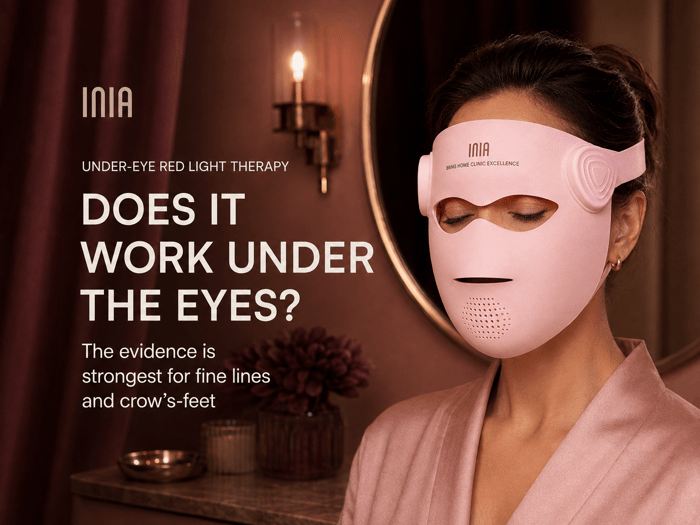

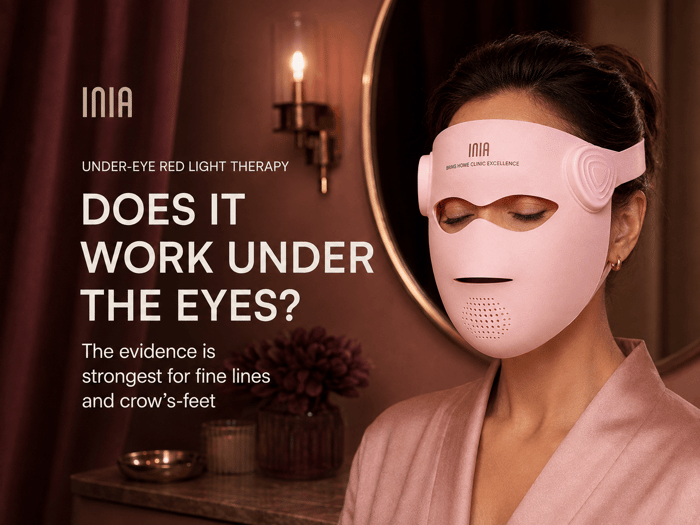
Human studies give the clearest support to using red light for under-eye fine lines and crow’s-feet. Dark circles and puffiness need a cause-specific decision, while light cannot correct structural eye bags or hollows.
Table of Contents
Why Red Light Can Affect Skin
Red and near-infrared photons can be absorbed by light-sensitive structures in skin cells. Photobiomodulation research describes resulting changes in mitochondrial activity and cellular signaling involved in tissue maintenance and repair.1
This mechanism makes red light biologically plausible for skin-aging applications. Human trials provide the stronger answer to the question users actually care about: can a defined light protocol change the visible appearance of wrinkles?
What Human Studies Found Around the Eyes
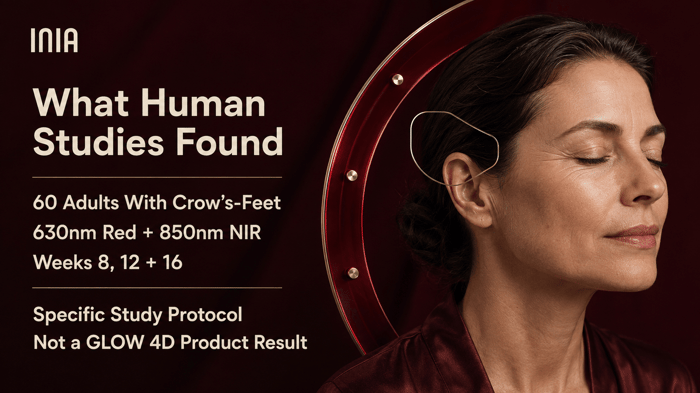
A 2025 multicenter, randomized, double-blind, sham-controlled study enrolled 60 adults with crow’s-feet. The test mask used 630nm red light and 850nm near-infrared light. Independent raters and investigators found significant differences between the test and sham groups at weeks 8, 12, and 16.2
A separate randomized split-face trial enrolled 137 women. Participants received ten sessions over four weeks, with 660nm red light on one side of the face and 590nm amber light on the other. Periocular wrinkle volume decreased by 31.6% on the red-light side and 29.9% on the amber-light side.3
A smaller six-week under-eye study tested a commercial device combining 633nm red light and 830nm near-infrared light in 11 participants. Users reported improvement and high satisfaction, although the objective wrinkle-score change was small and did not reach statistical significance.4
Which Under-Eye Concerns Fit Red Light?
Under-eye darkness can come from pigmentation, visible vessels, thin skin, soft-tissue changes, or shadows created by a tear trough. Clinical reviews recommend identifying the cause before choosing a treatment.5
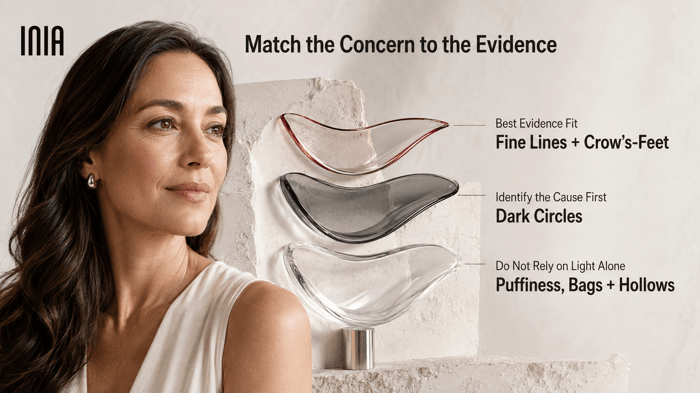
| Your main concern | Choose red light? | Reason |
|---|---|---|
| Fine lines or crow’s-feet | Yes | This is the under-eye goal with the clearest human evidence. |
| Thin, aging-looking skin | Potentially | It overlaps with the skin-aging direction tested in red-light studies. |
| Dark circles | Identify the cause first | Pigment, vessels, thin skin, and shadowing require different approaches. |
| Temporary puffiness | Do not rely on light alone | Current clinical evidence is insufficient for a dependable result. |
| Structural bags or hollows | No | Light cannot reposition fat or restore lost volume. |
For more help separating puffiness from dark circles, read the INIA guide to puffiness and dark circles. If thin skin is your main concern, see the under-eye thin-skin guide.
When GLOW 4D Is the Clear Product Choice
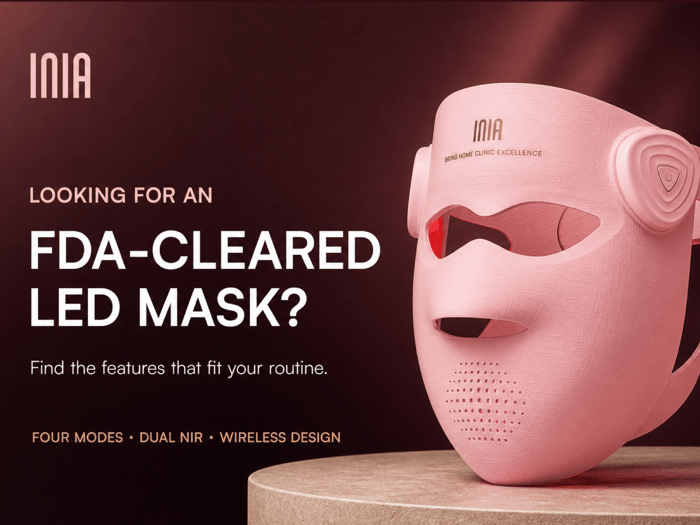
Choose the INIA GLOW 4D Wireless LED Light Therapy Mask when your goal is to include eye-area fine lines in a complete full-face anti-aging routine.
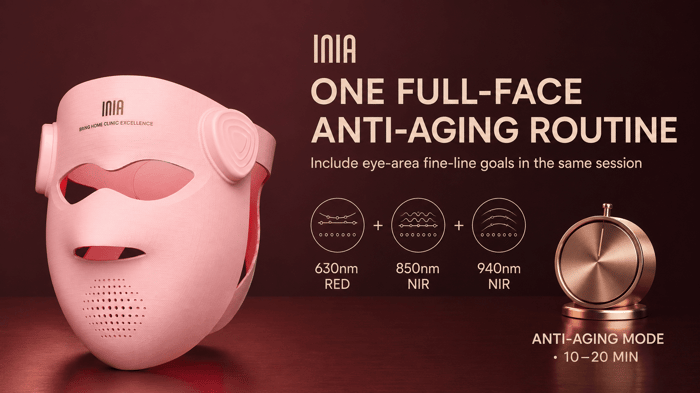
Its Anti-aging Mode combines 630nm red light with 850nm and 940nm dual near-infrared light in a stated 10–20-minute session. The 2025 sham-controlled mask trial studied 630nm and 850nm, giving those two wavelength categories direct relevance to crow’s-feet research. That trial did not test GLOW 4D or its additional 940nm wavelength, so its numerical results are not product-specific claims.
GLOW 4D removes the need to select and combine wavelengths yourself. Its 4D silicone fit supports full-face and lower-face coverage, wireless operation makes the routine easier to repeat, and optional magnetic under-eye cooling provides a soothing cooling sensation during use.
How to Use Light Around the Eyes Safely
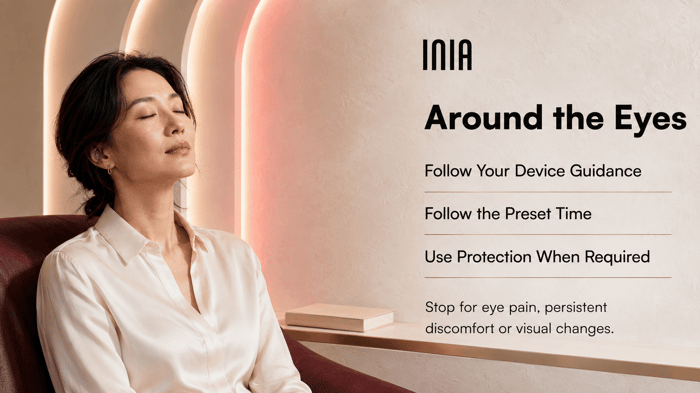
- Follow the eye guidance and session time for your exact device.
- Do not look toward illuminated LEDs.
- Use eye protection whenever the device instructions require it.
- Stop if you develop eye pain, persistent discomfort, or visual changes.
- Ask a clinician before use if you have an active eye condition, photosensitivity, or take photosensitizing medication.
Whether you keep your eyes open or closed depends on the device instructions and your comfort. Read the full INIA eye-position and comfort guide.
Choose Red Light for Fine-Line Goals
Human studies support red and near-infrared light for the appearance of eye-area fine lines and crow’s-feet. Dark circles need a cause-specific decision, while structural bags and hollows require other solutions. GLOW 4D turns the relevant wavelength categories into one defined full-face Anti-aging Mode.
Frequently Asked Questions
Does red light therapy help under-eye wrinkles?
Human trials support red light for improving the appearance of periocular fine lines and crow’s-feet when used as part of a defined protocol.
Can red light therapy remove dark circles?
Dark circles have pigmentary, vascular, skin-related, and structural causes. Red light is not a dependable solution for every type, so identify the cause first.
Which GLOW 4D mode should I choose for eye-area fine lines?
Choose Anti-aging Mode, which combines 630nm red light with 850nm and 940nm dual near-infrared light. Follow the stated 10–20-minute session time.
References
- Barolet AC, et al. Low-Intensity Visible and Near-Infrared Light-Induced Cell Signaling Pathways in the Skin: A Comprehensive Review. Photobiomodulation, Photomedicine, and Laser Surgery. 2023.
- Park SH, Park SO, Jung JA. Clinical study to evaluate the efficacy and safety of home-used LED and IRED mask for crow’s feet. Medicine. 2025.
- Mota LR, et al. Photobiomodulation Reduces Periocular Wrinkle Volume by 30%: A Randomized Controlled Trial. Photobiomodulation, Photomedicine, and Laser Surgery. 2023.
- Wang JY, et al. Outstanding user reported satisfaction for light emitting diodes under-eye rejuvenation. Archives of Dermatological Research. 2024.
- Vrcek I, Ozgur O, Nakra T. Infraorbital Dark Circles: A Review of the Pathogenesis, Evaluation and Treatment. Journal of Cutaneous and Aesthetic Surgery. 2016.