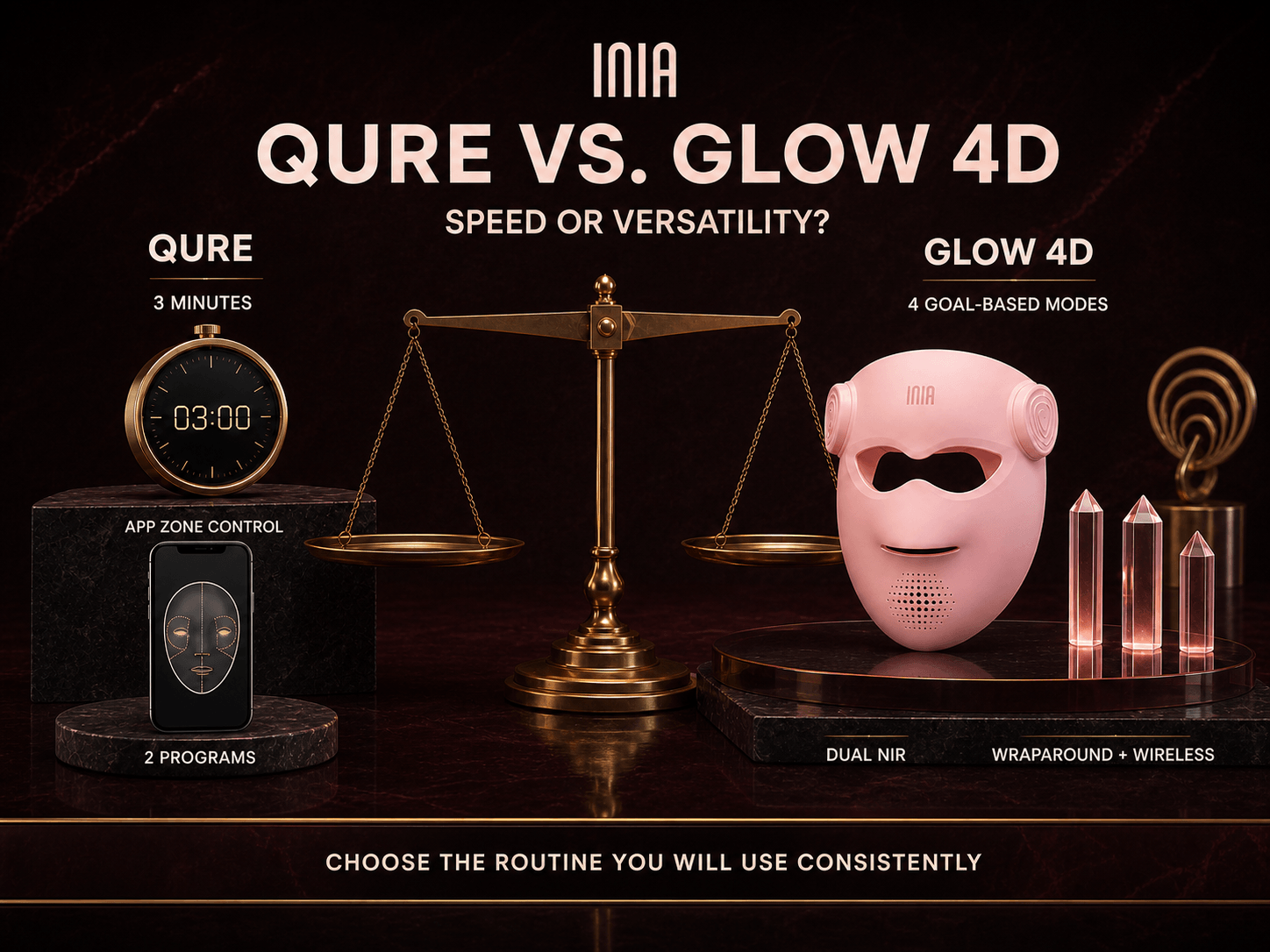
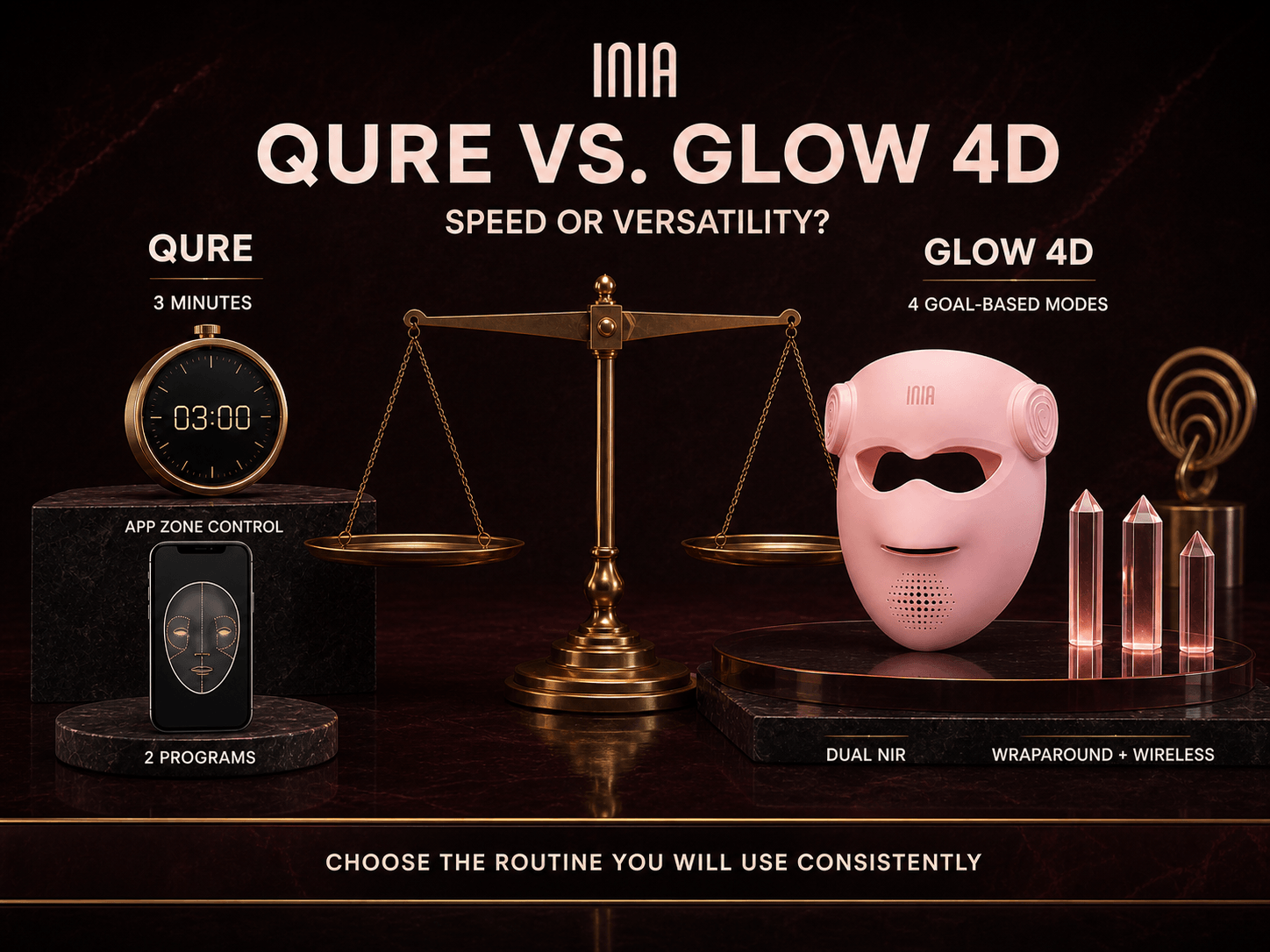
Choose the Qure LED Mask if a three-minute session and app-controlled treatment zones are your priorities. Its two programs focus on wrinkle and acne goals.
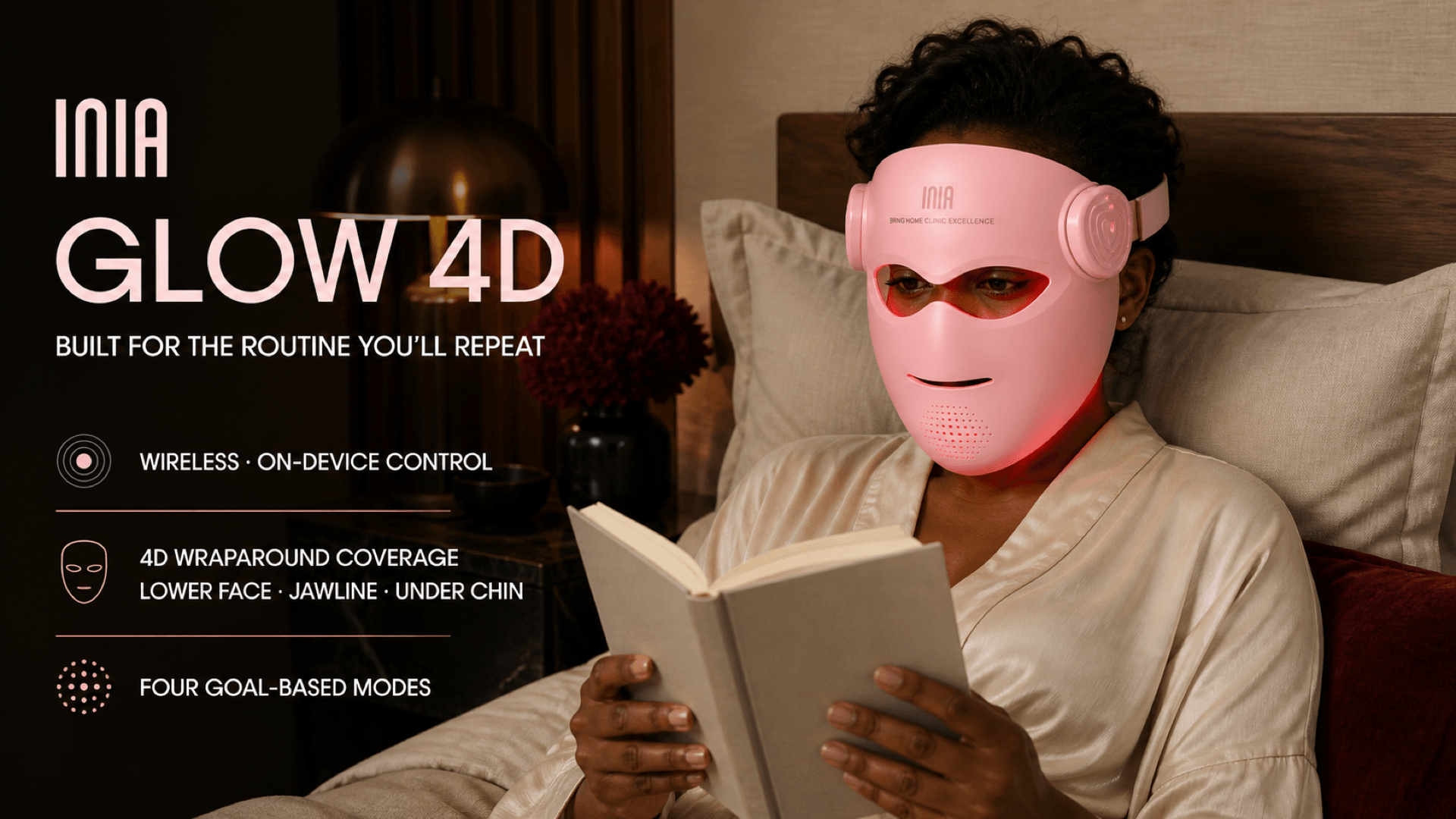
Choose INIA GLOW 4D if you want four goal-based routines, five wavelengths with 850nm and 940nm dual near-infrared light, expanded jawline and under-chin coverage, wireless use, and a lower current listed price.
Table of Contents
Qure LED Mask vs. INIA GLOW 4D: Quick Comparison
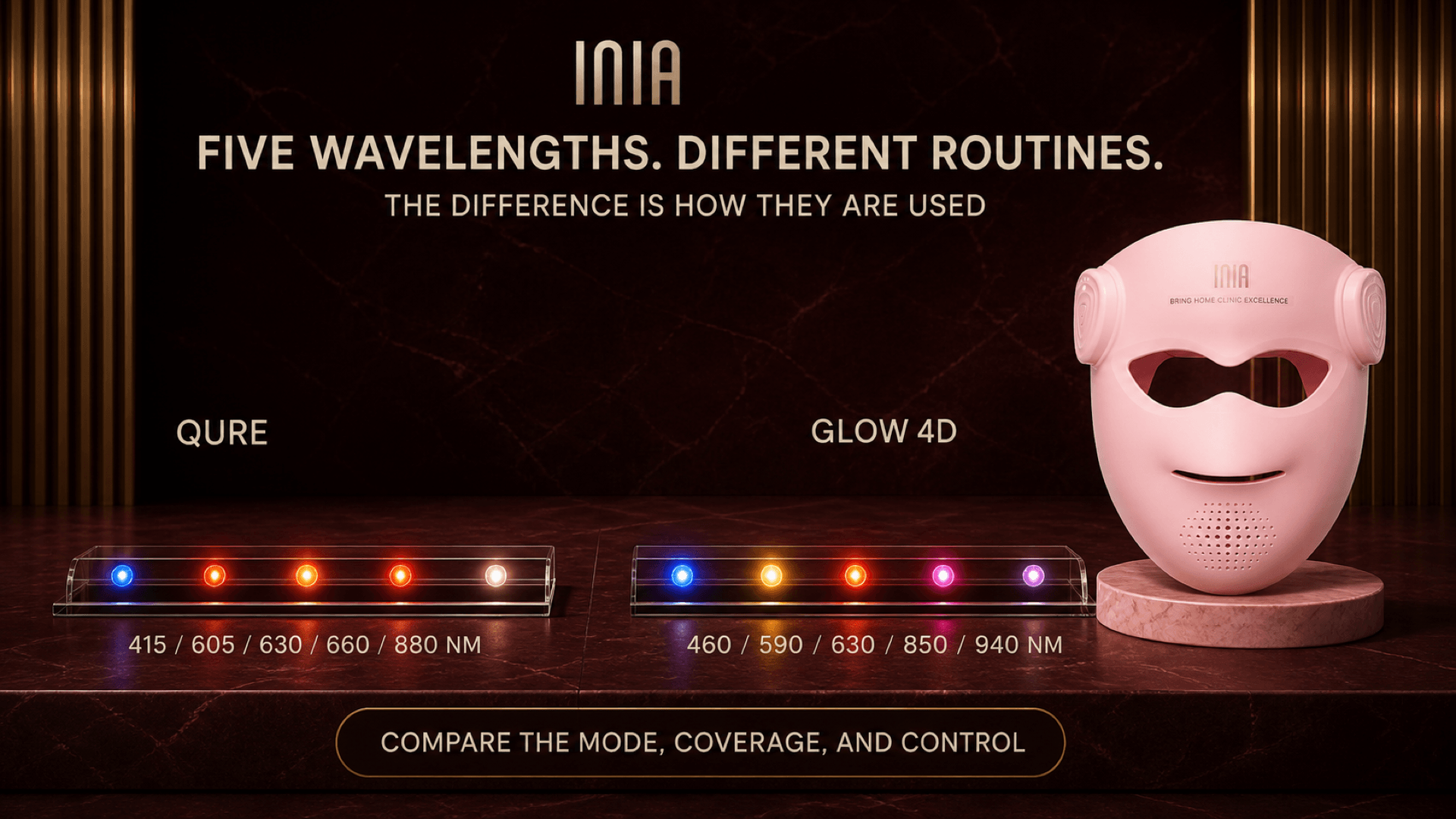
Both masks use five wavelengths, so the number alone does not separate them. The useful differences are how those wavelengths are grouped into routines, how long each routine takes, what area the mask is designed to cover, and how much control you want.
| Decision point | Qure LED Mask | INIA GLOW 4D |
|---|---|---|
| Wavelengths | 415, 605, 630, 660, 880nm | 460, 590, 630, 850, 940nm |
| Goal structure | Wrinkle and acne programs; app zone control | Anti-aging, Acne, Brightening, and Soothing modes |
| Session design | 3 minutes per program | 5–20 minutes, depending on mode |
| Coverage and control | Flexible facial mask; app-guided customization | 4D wraparound lower-face, jawline, and under-chin coverage; on-device controls |
| Current listed price | $399 | $209.99 |
Prices checked September 1, 2026; promotions can change. Qure wavelength and session specifications are documented in FDA 510(k) K230042.
Why Three Minutes Does Not Automatically Beat Twenty
A treatment time cannot be judged without wavelength, irradiance, delivered energy, treatment area, and distance from the skin. Photomedicine reporting standards treat these as connected dose parameters, not interchangeable marketing numbers (Jenkins and Carroll, 2011).
Qure's three-minute program is a real device-specific protocol, not a shortcut to dismiss. GLOW 4D's 5–20-minute sessions are also mode-specific. Compare the complete routine you will follow, rather than assuming that shorter means weaker or longer means stronger.
Wavelength-level research supports the broader category. A 2025 randomized home-use study found that a 630nm and 850nm mask improved several measured facial-aging outcomes versus sham use, while a 590nm study found early laboratory and small-pilot signals related to pigmentation and redness (Park et al., 2025; Jo et al., 2022).
Choose a verified wavelength-and-mode combination for your goal, then follow that device's specified session time.
Which Mask Better Matches Your Skin Goals?
Qure keeps the decision simple: its FDA-cleared indications cover full-face wrinkles and mild-to-moderate inflammatory acne, and its app can assign programs to facial zones. That makes sense if those are your two priorities and you value a very short routine.
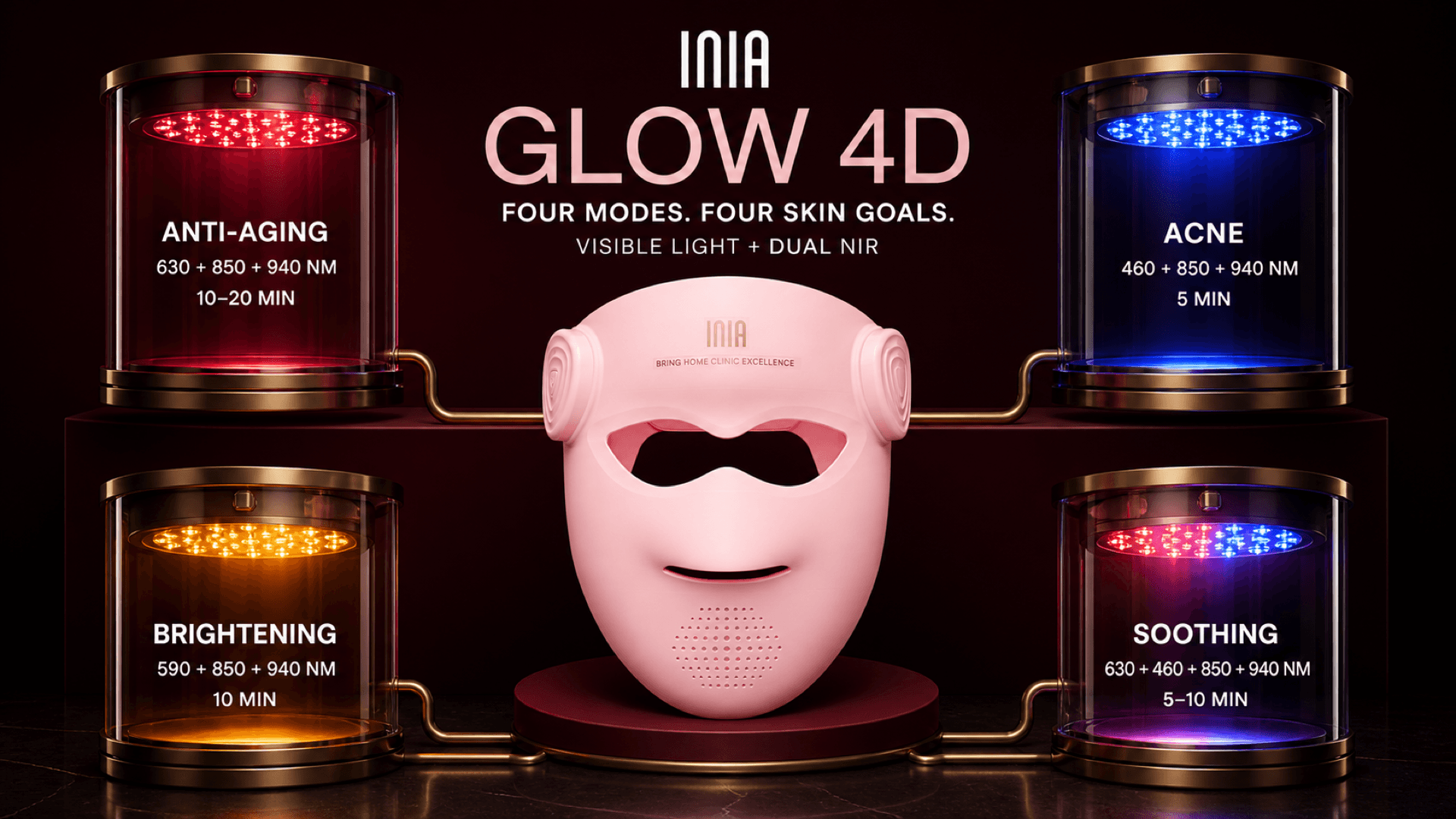
INIA GLOW 4D Wireless LED Light Therapy Mask gives you four distinct appearance-focused routines:
- Anti-aging: 630nm red plus 850nm and 940nm dual NIR for 10–20 minutes.
- Acne: 460nm blue plus dual NIR for 5 minutes, for blemish-prone or oily-looking skin.
- Brightening: 590nm orange plus dual NIR for 10 minutes, for brighter-looking, more even-looking skin.
- Soothing: 630nm red, 460nm blue, and dual NIR for 5–10 minutes, for visible redness.
That mode map is GLOW 4D's clearest advantage. You can select the current appearance goal directly instead of translating a general wavelength list into your own routine. See how LED colors map to different skin goals for a deeper explanation.
Which Routine Is Easier to Live With?
Qure wins on speed and app-guided zone control. If three minutes is the reason you will use an LED mask consistently, that is a meaningful advantage.
GLOW 4D wins on mode choice and physical coverage. Its flexible 4D design extends around the lower face, jawline, and under the chin; the mask is wireless, and magnetic under-eye CryoCooling provides a soothing cooling sensation. Controls stay on the device, so the routine does not depend on opening an app.
Fit remains personal with any face mask. Judge strap stability, eye and nose alignment, lower-edge contact, and comfort during the full session before the return window closes.
Who Should Choose Each Mask?
Choose Qure if you want:
- a three-minute session;
- app-controlled facial zones;
- a routine centered on wrinkle and acne goals.
Choose GLOW 4D if you want:
- four clearly labeled skin-goal modes;
- 850nm and 940nm dual NIR plus 590nm orange;
- wireless wraparound jawline and under-chin coverage;
- the lower current listed price.
GLOW 4D Offers the More Versatile Product Answer
Qure is the better fit for shoppers who value a three-minute, app-guided wrinkle-and-acne routine. GLOW 4D is the stronger choice for shoppers who want more goal-based modes, dual NIR, expanded lower-face coverage, wireless use, and a lower current listed price.
Frequently Asked Questions
Is the Qure LED Mask worth it?
It can be worth it if three-minute sessions and app zone control are the features most likely to keep you consistent. GLOW 4D offers broader goal-based routines and a lower current listed price.
Is Qure's three-minute session enough?
Three minutes is Qure's documented device-specific program. Session time should be judged with wavelength, irradiance, treatment area, and delivered energy, not compared by minutes alone.
Which mask has more wavelengths?
Both list five wavelengths. The important difference is how each mask combines them into modes for specific skin goals.
Which mask is better for acne concerns?
Qure has an FDA-cleared indication for mild-to-moderate inflammatory acne. GLOW 4D's 460nm Acne mode is positioned for the appearance of blemish-prone or oily-looking skin and is not presented as medical treatment.
Does GLOW 4D use both 850nm and 940nm near-infrared light?
Yes. Both NIR wavelengths are combined with the visible-light modes by default; near-infrared light itself is invisible.
References
- U.S. Food and Drug Administration. 510(k) Summary K230042: Q-Rejuvalight Pro Facewear.
- Jenkins, P. A., & Carroll, J. D. (2011). How to Report Low-Level Laser Therapy/Photomedicine Dose and Beam Parameters in Clinical and Laboratory Studies. Photomedicine and Laser Surgery.
- Park, K. Y., et al. (2025). Effects of an At-Home Red-Light Mask on Wrinkles and Skin Biophysical Properties. Journal of Cosmetic Dermatology.
- Jo, D. J., et al. (2022). Photobiomodulation with 590 nm Light-Emitting Diodes Suppresses Melanogenesis through a Mechanism Involving Antivascular Effects. Cells.
- INIA. INIA GLOW 4D Wireless LED Light Therapy Mask.