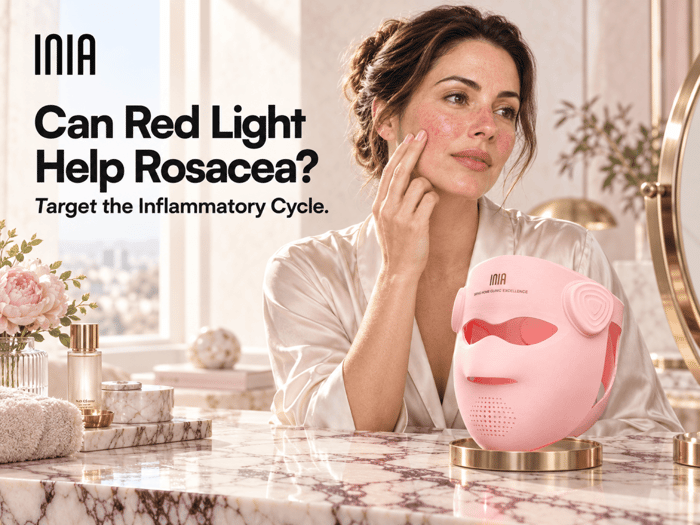

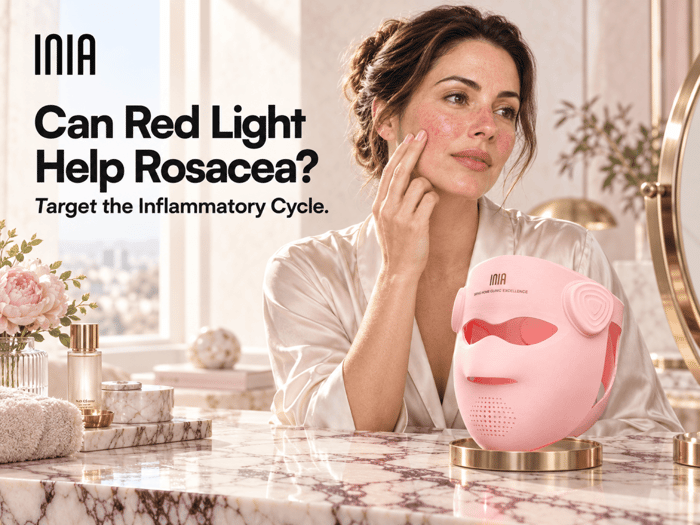
Red and near-infrared LED therapy may help the inflammation-driven side of rosacea by calming the signals that sustain diffuse redness. In cell and rosacea-like mouse studies, 630/940nm and 590/830nm light reduced key inflammatory mediators, abnormal immune activity, angiogenesis markers, and erythema.
An at-home LED mask follows this low-energy photobiomodulation pathway. Fixed visible capillaries follow a different pathway and are addressed with professional vascular laser or IPL.
Table of Contents
Why Rosacea Stays Red
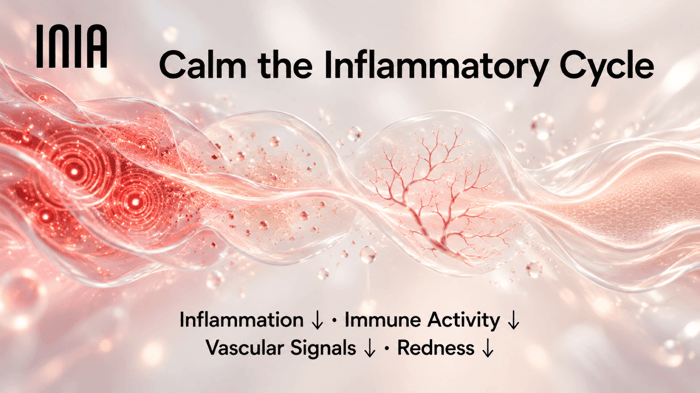
Rosacea redness begins with more than surface blood vessels. Rosacea-prone skin can overexpress Toll-like receptor 2 (TLR2), kallikrein 5 (KLK5), and the antimicrobial peptide LL-37. This combination amplifies inflammatory signaling and recruits immune cells into the skin.
The inflammatory environment then affects the vascular system. Research has connected rosacea flare activity with type I interferon and IL-22 signaling that supports endothelial-cell survival and new blood-vessel growth. The visible result is a cycle of inflammation, flushing, persistent erythema, and increasingly noticeable vessels (Mylonas et al., 2023).
Abnormal inflammatory signaling activates immune cells, inflammatory cells reinforce vascular growth, and that vascular response sustains visible redness.
How Red and Near-Infrared LED Light Interrupts the Cycle
At-home red light therapy uses photobiomodulation. The light changes cellular signaling without creating the vessel-closing heat used by a vascular laser. Two studies show where this lower-energy pathway can act in rosacea biology.
A 2016 study exposed human keratinocytes and rosacea-like mouse skin to LED light across several wavelengths. At 630nm and 940nm, the researchers measured lower expression of TLR2, KLK5, and LL-37. They also found lower protease activity, mCAMP, and IL-8 after repeated 630/940nm exposure in the mouse model (Lee et al., 2016).
A 2022 study used 590nm and 830nm photobiomodulation in an LL-37-induced mouse model. Redness scores and inflammatory-cell counts fell. The study also measured lower p65 and S100A9, less dysregulated neutrophil, macrophage, gamma-delta T-cell, and regulatory T-cell infiltration, and lower CD31 expression, a marker used to track angiogenesis (Wu et al., 2022).
These results form one direct biological sequence: selected LED wavelengths lowered rosacea-related inflammatory signals, reduced abnormal immune recruitment, reduced an angiogenesis marker, and lowered visible erythema in the model. A 2025 review reached the same overall direction after evaluating the available experimental and clinical literature, identifying reduced pro-inflammatory signaling, immune infiltration, and rosacea hallmarks as the central PBM pathway (Boaretto Netto et al., 2025).
Why Vascular Laser and Home LED Work Differently
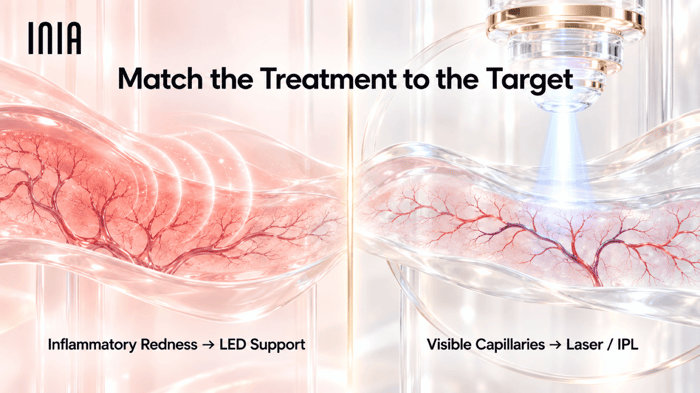
Diffuse inflammatory redness and fixed visible vessels are two different targets. Pulsed dye laser, KTP laser, and IPL direct higher-energy light toward hemoglobin in superficial vessels. The absorbed energy becomes localized heat, producing selective photothermal injury that closes targeted vessels. Clinical studies support these professional devices for persistent erythema and telangiectasia (Alam et al., 2013).
A home LED mask uses lower-intensity, non-ablative light. Its job is to influence the inflammatory environment that keeps redness active. It should not be described as heating, coagulating, or erasing facial vessels. The American Academy of Dermatology also presents laser and light procedures as one part of a dermatologist-directed rosacea plan (American Academy of Dermatology).
How INIA GLOW 4D Maps to the Research
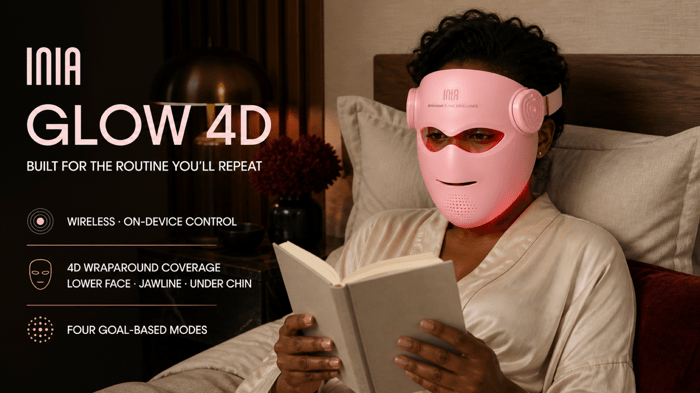
The practical product question is whether a mask discloses relevant wavelengths and turns them into a repeatable session. INIA GLOW 4D Wireless LED Light Therapy Mask uses five wavelengths across four named routines. Two modes connect most directly with the rosacea research above.
Redness-first routine
Brightening Mode
- 590nm orange light
- 850nm and 940nm dual NIR
- Defined 10-minute session
- Product guidance maps this mode to redness-prone and uneven-looking skin
Closest wavelength pair
Anti-Aging Mode
- 630nm red light
- 850nm and 940nm dual NIR
- Defined 10–20-minute session
- Contains the 630/940nm pair investigated by Lee et al.
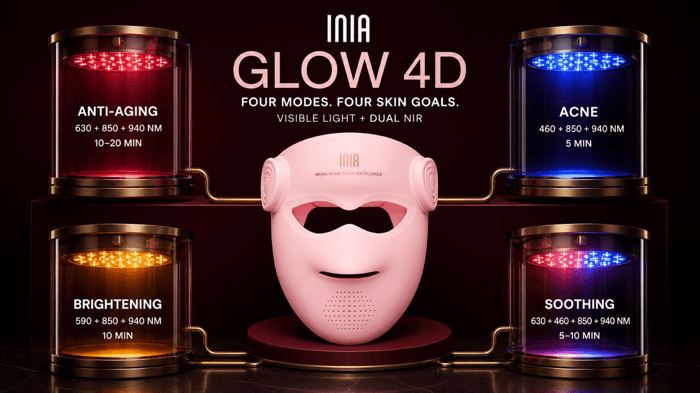
The cited studies did not test GLOW 4D as a finished device. The product connection is wavelength overlap and routine design: Brightening Mode includes the studied 590nm band, while Anti-Aging Mode includes the studied 630nm and 940nm pair.
The regular GLOW 4D array uses 80 LED beads with four chips per bead, for 320 light chips. Its flexible 4D fit follows the jawline, lower face, and under-chin area. Wireless operation and magnetic under-eye cooling packs reduce routine friction; the cooling packs support comfort rather than acting as the scientific mechanism.
A Gentle GLOW 4D Routine for Rosacea-Prone Skin
Use one simple starting routine instead of switching among colors:
- Patch test first. Run one 10-minute session on the inner arm, then wait at least six hours before facial use.
- Start with clean, dry skin. Remove makeup, creams, and lotions so light reaches the skin directly.
- Select Brightening Mode. This activates 590nm orange with 850nm and 940nm dual NIR. NIR is on by default.
- Begin with five minutes, twice weekly. If the skin remains calm, build toward the mode's 10-minute session and two to three sessions per week.
- Stop the session manually. GLOW 4D does not have a confirmed automatic shutoff, so use a timer.
- Moisturize after the session. Add a simple, non-irritating moisturizer after light exposure.
Refrigerate the magnetic cooling packs for one to two hours when you want extra comfort. Do not freeze them. Pause the routine if a session creates sustained flushing, burning, itching, unusual warmth, or a visible flare.
For a broader schedule framework, see how often to use a red light therapy mask. Review the LED-mask contraindications before starting if you have a photosensitive condition or take photosensitizing medication.
Use LED to Target the Inflammatory Cycle
Red light therapy for rosacea follows a photobiomodulation pathway: lower abnormal inflammatory signaling, regulate immune-cell activity, reduce inflammation-driven angiogenesis signals, and support calmer-looking skin.
GLOW 4D turns the relevant wavelength bands into a practical routine through 590/850/940nm Brightening Mode and 630/850/940nm Anti-Aging Mode. Start gently, keep the routine consistent, and judge it by changes in diffuse redness and skin comfort. Use professional vascular care for fixed visible capillaries.
Frequently Asked Questions
Does red light therapy help rosacea?
It may help inflammation-driven redness. Cell and rosacea-like mouse studies found that selected red, orange, and near-infrared wavelengths reduced inflammatory mediators, abnormal immune activity, angiogenesis markers, and erythema. Evidence for at-home LED masks remains earlier than the evidence for dermatologist-operated vascular devices.
Which wavelengths have been studied for rosacea?
Direct mechanistic studies include 630nm plus 940nm LED light and 590nm plus 830nm photobiomodulation. Research protocols differ in power, fluence, exposure time, and treatment schedule, so matching a wavelength alone does not reproduce a study.
Can a red light mask remove broken capillaries?
No. A home LED mask does not deliver selective photothermal vessel closure. Fixed telangiectasia is a professional vascular-laser or IPL question.
Which GLOW 4D mode should redness-prone users start with?
Start with Brightening Mode, which combines 590nm orange with 850nm and 940nm dual NIR. Begin with a five-minute session twice weekly, then move toward the defined 10-minute session if your skin remains calm.
Can LED light make rosacea redness worse?
Any routine that increases warmth, irritation, or flushing can aggravate reactive skin. Stop when redness intensifies or persists, and avoid beginning during a severe active flare. Seek dermatology guidance for persistent redness, painful flares, eye symptoms, or visible vessels that you want treated.
References
- Lee, J. B., et al. (2016). Light-emitting diodes downregulate cathelicidin, kallikrein and toll-like receptor 2 expressions in keratinocytes and rosacea-like mouse skin. Experimental Dermatology.
- Wu, S., et al. (2022). The effects of photobiomodulation therapy on inflammatory mediators, immune infiltration, and angiogenesis in a mouse model of rosacea. Annals of Translational Medicine.
- Mylonas, A., et al. (2023). Type I IFNs link skin-associated dysbiotic commensal bacteria to pathogenic inflammation and angiogenesis in rosacea. JCI Insight.
- Su, Y., et al. (2023). Efficacy and tolerance of oral minocycline combined with photobiomodulation therapy for rosacea. Photodermatology, Photoimmunology & Photomedicine.
- Boaretto Netto, J. C., et al. (2025). Could photobiomodulation be used for treatment of rosacea? Lasers in Medical Science.
- Alam, M., et al. (2013). Comparative effectiveness of nonpurpuragenic 595-nm pulsed dye laser and microsecond 1064-nm Nd:YAG laser for diffuse facial erythema. Journal of the American Academy of Dermatology.
- American Academy of Dermatology: Lasers and lights—how well do they work for rosacea?
- INIA GLOW 4D Wireless LED Light Therapy Mask