


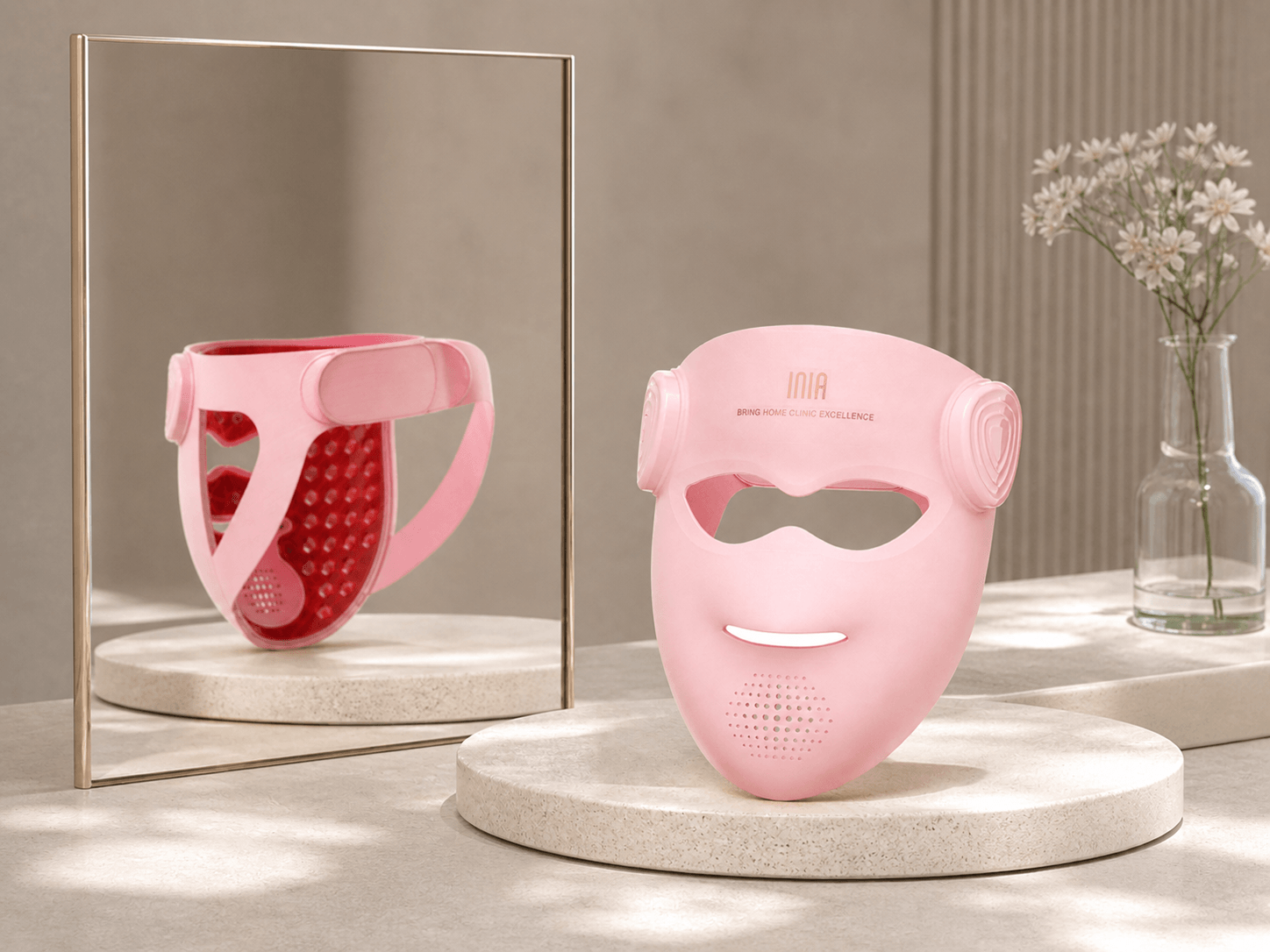
Aphrona's acne and anti-aging claims follow established LED pathways: blue light acts on acne-related bacterial porphyrins, while red and near-infrared light support cellular activity linked to inflammation, collagen, and elasticity.
INIA GLOW 4D turns those same principles into five disclosed wavelengths, four goal-based modes, and clear session times.
Table of Contents
The Science Behind Aphrona's Two Claims
Blue light can excite porphyrins produced by acne-related bacteria. That reaction creates reactive oxygen species that reduce bacterial activity. Red light adds a photobiomodulation pathway associated with inflammatory signaling. In a randomized home-use study, a defined 420nm blue and 660nm red combination improved mild-to-moderate acne.1
Red and near-infrared light act through cellular signaling that supports fibroblast activity. A randomized, double-blind study using 633nm red and 830nm near-infrared light measured improvements in wrinkles and elasticity alongside increased collagen and elastic fibers.2
Acne: blue light → bacterial porphyrins → reactive oxygen species → lower acne-related bacterial activity.
Visible aging: red and near-infrared light → cellular signaling → fibroblast activity → collagen and elastic-fiber support.
Aphrona's red- and blue-light concept therefore starts from real science. The practical next question is how clearly a device connects each skin goal to a wavelength combination and session time.
How INIA GLOW 4D Applies the Science
INIA GLOW 4D Wireless LED Light Therapy Mask organizes five disclosed wavelengths into four ready-to-use modes. For the two concerns in this review, the choice is direct.
For blemish-prone skin
Acne Mode
- 460nm blue light
- 850nm and 940nm dual NIR
- Defined 5-minute session
Soothing Mode adds 630nm red to the same blue and dual-NIR combination for a 5–10-minute session.
For visible aging
Anti-Aging Mode
- 630nm red light
- 850nm and 940nm dual NIR
- Defined 10–20-minute session
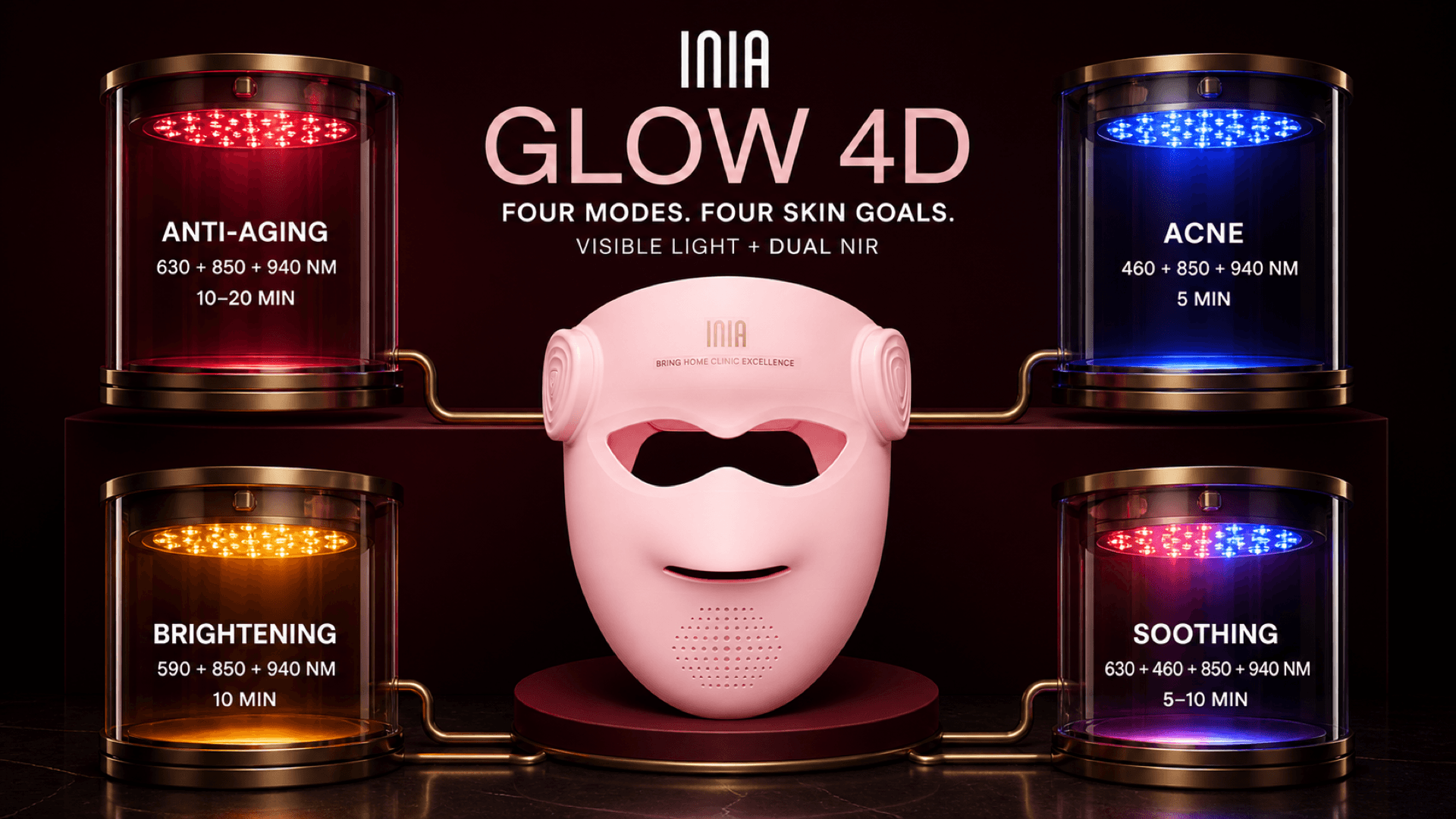
The 460nm blue channel sits within the blue-light range used in acne research. The 630nm red channel is close to the 633nm and 660nm bands used in published acne and rejuvenation studies. Every mode also includes 850nm and 940nm dual near-infrared light.
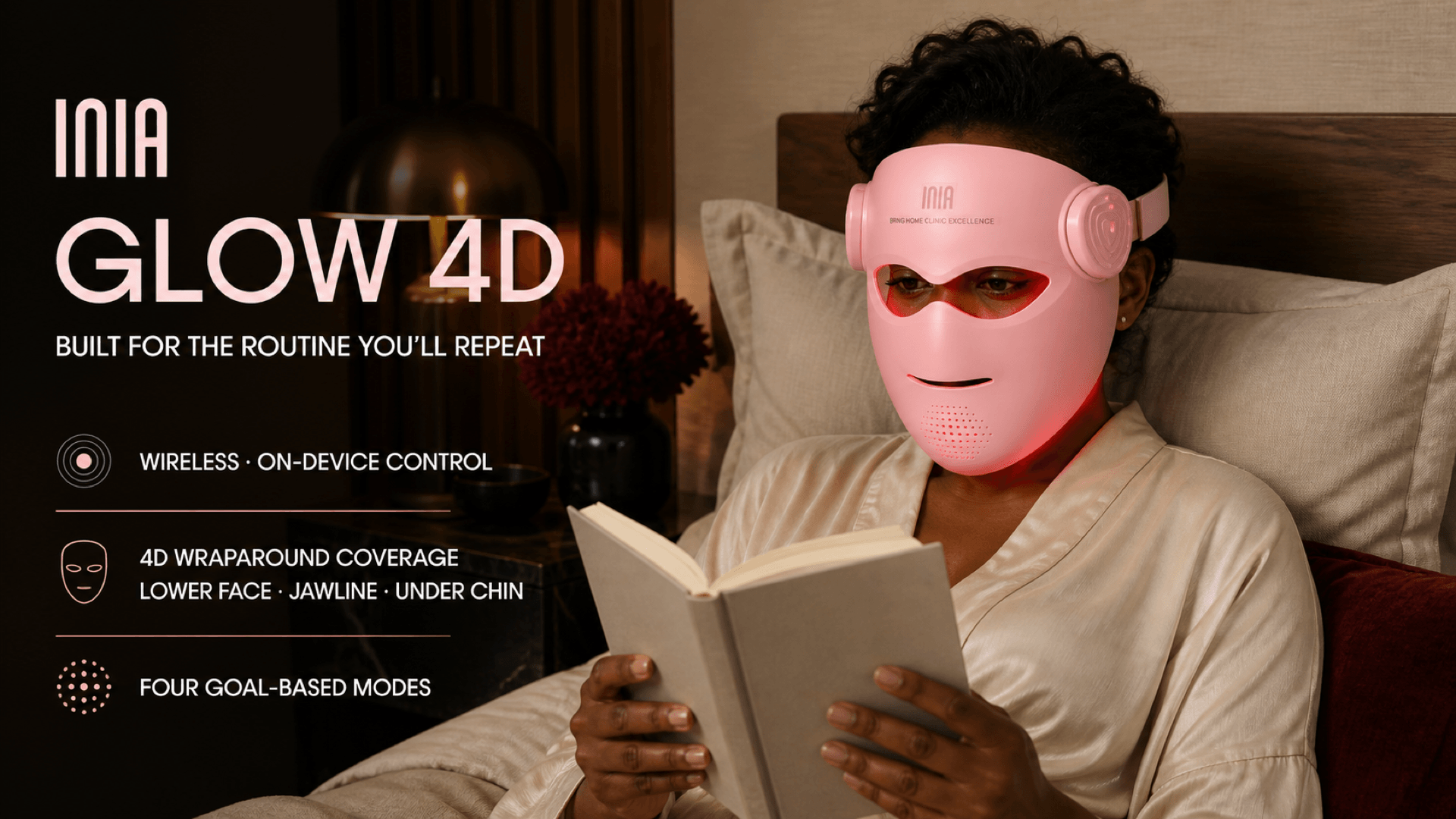
The regular GLOW 4D array uses 80 LED beads with four chips per bead, for 320 light chips. Its flexible 4D fit covers the lower face, jawline, and under-chin area. Wireless operation and magnetic under-eye cooling packs make the routine easier to repeat.
A Simple GLOW 4D Routine
- Start with clean, dry skin.
- Choose one primary goal. Use Acne Mode for a 5-minute blemish-focused session, Soothing Mode for a 5–10-minute mixed-concern session, or Anti-Aging Mode for a 10–20-minute session.
- Begin two to three times per week if your skin is sensitive, then build toward three to five sessions when the skin remains comfortable.
- Apply a simple moisturizer after the session.
Bottom Line
Aphrona's acne and anti-aging claims begin with scientifically relevant light categories. The useful product answer connects those categories to exact wavelengths, a skin goal, and a repeatable session.
GLOW 4D makes that connection explicit through 460nm blue, 590nm orange, 630nm red, and dual 850/940nm near-infrared light across four ready-to-use modes.
Frequently Asked Questions
Does the Aphrona LED face mask use scientifically relevant light?
Its red- and blue-light concept aligns with the light categories used in acne and skin-rejuvenation research. Wavelength, dose, fit, and consistent use determine how that general concept becomes a treatment routine.
Why combine red and blue light for blemish-prone skin?
Blue light acts on porphyrins produced by acne-related bacteria. Red light adds a photobiomodulation pathway associated with inflammatory signaling.
Does a higher LED count mean a mask works better?
Not by itself. Wavelength, irradiance, session time, fit, coverage, and consistent use determine how light is delivered to the skin.
Which GLOW 4D modes address acne and anti-aging concerns?
Acne Mode uses 460nm blue with dual 850/940nm NIR for 5 minutes. Anti-Aging Mode uses 630nm red with dual NIR for 10–20 minutes. Soothing Mode combines red, blue, and dual NIR for mixed concerns.
References
- Kwon, H. H., et al. (2013). The clinical and histological effect of home-use, combination blue-red LED phototherapy for mild-to-moderate acne vulgaris. British Journal of Dermatology.
- Lee, S. Y., et al. (2007). A prospective, randomized, placebo-controlled, double-blinded, split-face clinical study on LED phototherapy for skin rejuvenation. Journal of Photochemistry and Photobiology B.
- Avci, P., et al. (2013). Low-level laser (light) therapy in skin: stimulating, healing, restoring. Seminars in Cutaneous Medicine and Surgery.
- INIA. INIA GLOW 4D Wireless LED Light Therapy Mask.