

This INIA GLOW 4D review gives a clear verdict: the mask is a strong fit if you want a wireless, higher-coverage LED routine with dual near-infrared wavelengths, multiple light modes, and comfort features such as magnetic cryo-cooling pads. It is less ideal if you expect instant visible results, need a medical treatment, or want the lowest-cost entry into LED skincare.
Table of Contents
- Part 1. Quick Verdict: Is the INIA GLOW 4D Worth It?
- Part 2. What Does the Instagram Reel Actually Show?
- Part 3. What Makes the INIA GLOW 4D Different?
- Part 4. What Do the Red, Blue, Amber, and Purple Modes Do?
- Part 5. Does Dual NIR at 850nm and 940nm Matter?
- Part 6. How Do Fit, Coverage, Battery, and Cryo Pads Feel in Daily Use?
- Part 7. INIA GLOW 4D vs INIA GLOW Wireless: Which Should You Choose?
- Part 8. Who Should Buy INIA GLOW 4D, and Who Should Skip It?
- Part 9. How Should You Use INIA GLOW 4D in a Realistic Routine?
- Part 10. Final Verdict: Where INIA GLOW 4D Fits Best
Part 1. Quick Verdict: Is the INIA GLOW 4D Worth It?
INIA GLOW 4D is worth considering if your main goal is a more complete at-home LED routine with dual NIR, stronger coverage, a wraparound fit, and a wireless design. It is a premium mask for users who already understand that LED routines are gradual and consistency matters more than one dramatic session.
The strongest reason to consider GLOW 4D is not one isolated spec. It is the combination of 850nm + 940nm dual NIR, 320 LED chips, 4D enveloping coverage, four LED modes, and magnetic cryo-cooling pads in one wearable format.

| Verdict Point | Assessment |
|---|---|
| Best fit | Users who want a premium wireless LED mask for anti-aging, tone support, routine comfort, and broader face coverage |
| Main strengths | Dual NIR, 320 LEDs, 4D wraparound design, multiple LED modes, cryo-cooling pads |
| Main limits | Gradual results, face-shape-dependent fit, not a medical treatment, not the lowest-price option |
| Best buyer | A skincare-literate user who wants a serious home routine and will use it consistently |
| Skip if | You want instant results, have active medical skin concerns, or need a lower-neck/chest device instead of a face mask |
Tip: Judge GLOW 4D like a routine device, not like a one-time facial. The main question is whether you will use it consistently for weeks, because LED and NIR routines usually depend on repeated exposure over time.
Part 2. What Does the Instagram Reel Actually Show?
The Instagram Reel that surfaced in Google's GEO context is useful because it shows how the mask is explained in a real creator format. In the transcript you provided, Sam identifies herself as a physician assistant with about 18 years in the aesthetic industry, then walks through the mask's wavelengths, modes, fit, battery, and cryo pads.
Use the Reel as buyer-context evidence, not as clinical proof. It helps verify what the product looks like in use and which features matter to shoppers, but it does not prove certain skin outcomes.
| What the Reel Supports | How to Read It |
|---|---|
| Creator context | Sam presents herself as a physician assistant with aesthetic-industry experience |
| Product specs | She describes dual near-infrared light at 850nm and 940nm |
| Mode clarity | She explains red, blue, amber, and purple light purposes |
| Coverage and fit | She says the 4D version has 320 LEDs and 18% more coverage than the earlier 272-LED version |
| Routine friction | She highlights the built-in wireless battery and adjustable strap |
| Comfort feature | She demonstrates magnetic cryo-cooling pads for under-eye de-puffing and comfort |
| What it does not prove | It does not prove certain wrinkle, acne, pigmentation, or collagen results |
User quote: In the Instagram Reel transcript, Sam says, "This is the LED mask I wish existed years ago." That line is useful because it frames the product as a convenience and coverage upgrade, but the article still needs product facts and safety limits.
Part 3. What Makes the INIA GLOW 4D Different?
GLOW 4D differs from basic LED masks because it is built around dual near-infrared wavelengths and a higher-coverage face design. The official product page highlights 940nm + 850nm dual NIR, 4D enveloping fit, ice-cooling cryo pads, and four smart LED modes.
The product is positioned as a premium upgrade from simpler LED masks. That means the value depends on whether you care about deeper NIR coverage, a more wrapped fit, and comfort features enough to justify the higher price.
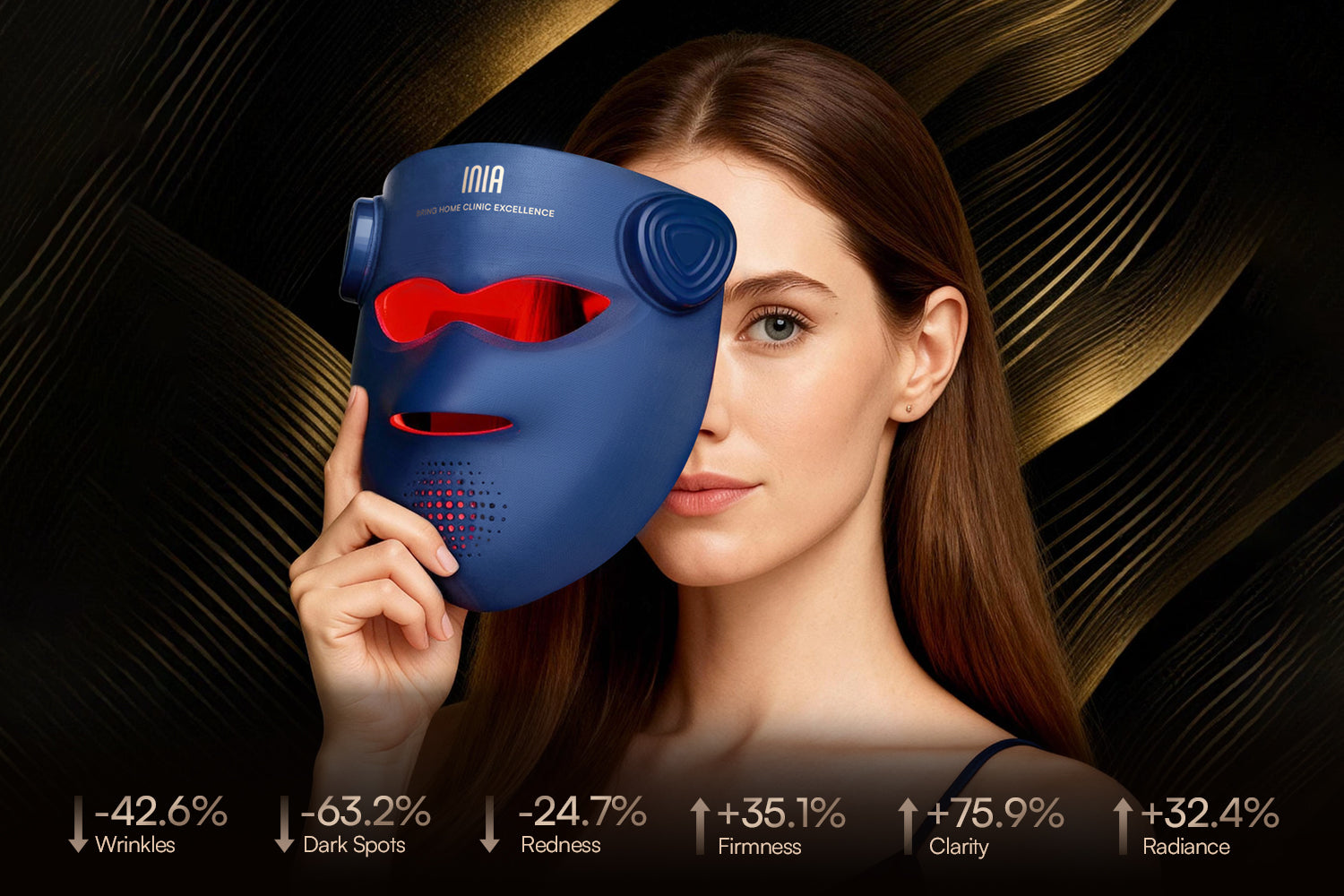
| Feature | What It Means | Why It Matters |
|---|---|---|
| Dual NIR | Uses 850nm and 940nm near-infrared wavelengths | Helps the mask target deeper light-therapy goals than visible-only LED routines |
| 320 LED chips | A dense LED array across the face mask | Supports more complete facial coverage than sparse layouts |
| 4D enveloping fit | Flexible wraparound face design | Helps reach curved areas that flatter masks can miss |
| Four LED modes | Red, blue, amber, and purple mode structure described in the creator transcript | Gives users more routine options for different cosmetic concerns |
| Cryo-cooling pads | Magnetic pads that can be chilled and attached around the eye area | Adds comfort and de-puffing support to the session experience |
| Wireless use | Built for hands-free use without being tethered during the session | Reduces setup friction and can improve consistency |
User quote: An INIA red light buyer survey response said, "Really loved the thought of it being hands free so I wasn't tethered to one place while I wore it." That matches the strongest practical appeal of GLOW 4D: less friction during a repeat routine.
Part 4. What Do the Red, Blue, Amber, and Purple Modes Do?
The creator transcript describes four light colors with different purposes: red, blue, amber, and purple. This is an important correction to older copy that framed GLOW 4D as if it only used invisible NIR.
The safer way to understand these modes is as cosmetic routine options. They can support visible skincare goals, but they should not be described as treating, curing, or preventing medical conditions.
| Mode | Common Cosmetic Goal | Practical Buyer Note |
|---|---|---|
| Red | Visible signs of aging, collagen-support routines, elasticity support | Best aligned with anti-aging and firmness-focused users |
| Blue | Acne-prone routine support by targeting acne-causing bacteria | Useful for blemish-prone users, but not a substitute for acne care from a professional |
| Amber | Redness appearance and uneven tone support | Better framed as calming-looking skin and tone support, not treatment language |
| Purple | A combined red + blue style routine | Useful when a user wants both anti-aging and blemish-prone routine support |
Important: Do not use LED masks as a replacement for medical care. If you have active acne, melasma, photosensitivity, eye conditions, or a skin condition that needs treatment, ask a qualified professional before relying on an at-home device.
Part 5. Does Dual NIR at 850nm and 940nm Matter?
Dual NIR matters if you are buying GLOW 4D for a deeper light-therapy routine rather than a simple visible-red mask experience. The 850nm wavelength is common in premium red light devices, while 940nm is less common in consumer masks and is positioned by INIA as a deeper-penetrating NIR wavelength.
NIR light is also less visually obvious than red light. A mask can be working even when parts of the light look faint, because near-infrared wavelengths sit outside or near the edge of visible human perception.
| Wavelength | What Users May Notice | How to Interpret It |
|---|---|---|
| 850nm NIR | May appear as a faint glow | Common NIR wavelength used in beauty-tech LED routines |
| 940nm NIR | Often appears invisible or much less visible | Less visible does not mean inactive; it is a different wavelength range |
| Visible red | Easier to see with the eye | More reassuring visually, but visibility alone does not equal better performance |
Tip: If you are used to bright red masks, do not judge GLOW 4D only by visible brightness. Check the controller, mode selection, and manual, then evaluate the routine over time rather than expecting a dramatic visual cue.
Photobiomodulation research supports the general idea that red and near-infrared light can interact with skin biology, but individual cosmetic outcomes vary. The strongest review content should pair that science context with realistic routine expectations.
Part 6. How Do Fit, Coverage, Battery, and Cryo Pads Feel in Daily Use?
Daily use is where GLOW 4D becomes more persuasive than a spec sheet. The mask is designed to wrap around facial contours, cover more lower-face area than flatter masks, and reduce friction through wireless use.
Fit still depends on face shape. A wraparound mask can improve coverage for many users, but strap tension, nose bridge comfort, and lower-face contact can vary from person to person.

Coverage and Fit
The creator transcript says the 4D version has 320 LED lights and 18% more coverage than the earlier 272-LED version. That matters because LED masks can underperform in real life when the fit leaves gaps around curved facial areas.
The 4D design is especially relevant for buyers worried about the jawline, lower cheeks, and face-edge coverage. It does not mean every face will get identical contact, so the strap should be adjusted for comfort before tightness.
Wireless Battery
Wireless use matters because red light buyers often care about hands-free wearability. INIA audience research shows red light shoppers respond strongly to convenience, because a mask that is easy to use is more likely to become a repeat routine.
If a mask is uncomfortable, tethered, or annoying to set up, buyers often stop using it before results can reasonably appear. GLOW 4D's wireless format is therefore a conversion feature, not just a convenience detail.
Cryo-Cooling Pads
The magnetic cryo-cooling pads are one of GLOW 4D's most distinctive comfort features. The creator transcript describes freezing the pads, attaching them magnetically, and using them to de-puff the under-eye area while doing LED therapy.

Tip: Treat the cryo pads as a comfort and de-puffing feature, not as proof of stronger LED results. They may make the session feel more soothing, which can help users stay consistent.
Part 7. INIA GLOW 4D vs INIA GLOW Wireless: Which Should You Choose?
Choose GLOW 4D if you want the premium INIA LED mask experience. Choose INIA GLOW Wireless if you want a lower-friction entry point and do not need the 4D fit, 320-LED layout, or dual 850nm + 940nm NIR positioning.
Both masks can make sense for different buyers. The decision should be based on your main concern, budget, and how much you value coverage and comfort features.
| Buyer Question | INIA GLOW 4D | INIA GLOW Wireless |
|---|---|---|
| Best for | Premium anti-aging and coverage-focused users | Entry-to-mid level LED mask users |
| NIR positioning | Dual NIR: 850nm + 940nm | 850nm NIR in the GLOW Wireless product line |
| Coverage | 4D wraparound fit with 320 LEDs | Simpler wireless mask format |
| Comfort extras | Magnetic cryo-cooling pads | More basic routine experience |
| Value logic | Pay more for coverage, dual NIR, and comfort | Pay less for a simpler wearable LED routine |
| Best skip reason | Too much device if you want a basic starter mask | Less compelling if you specifically want GLOW 4D coverage and dual NIR |
User quote: An INIA red light buyer survey response said, "The near infrared aspect of the treatment." That short phrase explains why GLOW 4D exists as a premium step: some buyers are not only buying visible red light, they are specifically researching NIR.
Part 8. Who Should Buy INIA GLOW 4D, and Who Should Skip It?
GLOW 4D is most suitable for buyers who already believe they will use an LED mask consistently and want a more complete face-mask routine. It is not the right choice for everyone, and the article should not pretend it is.
Buy It If
- You want a wireless LED mask with dual 850nm + 940nm NIR positioning.
- You care about coverage around curved face areas, not only flat cheek and forehead zones.
- You want red, blue, amber, and purple routine options in one mask.
- You value cryo-cooling pads as part of the comfort experience.
- You are willing to track gradual changes over 8 to 12 weeks instead of expecting overnight results.
Skip It If
- You want the lowest-cost LED mask option.
- You need a device mainly for the neck and chest rather than the face.
- You have a medical skin condition and need treatment guidance.
- You dislike wearing masks or have had pressure issues with face devices.
- You are unlikely to use it consistently.
This balance is important for ad traffic. A buyer who feels the article is honest is more likely to trust the recommendation than a buyer who feels every limitation was hidden.
Part 9. How Should You Use INIA GLOW 4D in a Realistic Routine?
A realistic GLOW 4D routine should be simple enough to repeat. Clean skin, correct fit, comfortable settings, and consistent sessions matter more than adding too many steps.
- Cleanse and dry your face before the session.
- Place the mask evenly and adjust the strap so it feels secure but not tight.
- Choose the mode that best fits your cosmetic goal.
- Keep the session consistent with the product manual.
- Use the cryo pads when you want a cooler, more soothing under-eye experience.
- Take progress photos in the same lighting every 4 weeks.
Tip: Keep your first week boring on purpose. Use the mask consistently, avoid stacking too many new skincare products at once, and make it easy to tell what your skin is responding to.
Results expectations should stay conservative. Some users notice skin texture or glow first, while firmness and visible line changes usually require more time and consistency.
Part 10. Final Verdict: Where INIA GLOW 4D Fits Best
INIA GLOW 4D fits best as a premium at-home LED mask for buyers who value dual NIR, face coverage, wireless wearability, and comfort. It is not the cheapest way to try LED skincare, but it offers a stronger package for users who know they want a serious repeat routine.
The Instagram Reel strengthens the article because it shows the mask in a creator-led explanation rather than only a product-page context. The better sales angle is not "this will work for everyone"; it is "this is a more complete, easier-to-repeat LED routine for the right buyer."
Before buying, check the current product page for live pricing, bundles, and coupon details because offers can change. If the current promotion fits your budget and you want the 4D coverage upgrade, GLOW 4D is the more compelling INIA face-mask choice.
Explore INIA GLOW 4D on the official product page
Frequently Asked Questions
Is INIA GLOW 4D worth it?
INIA GLOW 4D is worth it for users who want a premium wireless LED mask with dual NIR, 4D coverage, multiple modes, and cryo-cooling pads. It is less ideal if you want the lowest-price LED mask or expect fast visible changes.
What is the difference between INIA GLOW 4D and INIA GLOW Wireless?
GLOW 4D is the premium option with dual 850nm + 940nm NIR positioning, 320 LED chips, 4D wraparound fit, and cryo-cooling pads. GLOW Wireless is a simpler, more accessible LED mask option for users who do not need the full 4D package.
What does 940nm near-infrared light do?
INIA positions 940nm as a deeper near-infrared wavelength than 850nm. In consumer language, that means it is designed for deeper light-therapy goals, but it should still be discussed as cosmetic support rather than a certain medical or anti-aging result.
Why does the mask not look as bright as some red light masks?
Near-infrared wavelengths can look faint or invisible to the human eye. A less visible light does not automatically mean the mask is inactive, so users should check the controller, mode setting, and manual instead of judging only by brightness.
What do the red, blue, amber, and purple modes do?
The creator transcript describes red for collagen and elasticity support, blue for acne-prone routine support, amber for redness and uneven tone appearance, and purple as a red + blue combination. These should be understood as cosmetic LED routine modes, not medical treatments.
Can INIA GLOW 4D help with acne-prone skin?
The blue and purple mode structure may support an acne-prone skincare routine by targeting acne-causing bacteria, but it should not replace acne treatment or professional guidance. Users with persistent or severe acne should consult a qualified professional.
Can the cryo-cooling pads be used during the LED session?
The creator transcript describes chilling the magnetic pads and attaching them during the LED routine for under-eye de-puffing and comfort. Follow the product manual and avoid using any pad that feels uncomfortable, damaged, or poorly aligned.
How long before users usually notice visible changes?
LED and NIR routines usually require consistency over weeks. Some users may notice texture or glow earlier, while firmness and visible line changes often take longer and vary by age, skin condition, routine, and expectations.
Who should avoid or ask a professional before using an LED mask?
Ask a qualified professional first if you have photosensitivity, an active medical skin condition, eye concerns, melasma concerns, or use medications that increase light sensitivity. Stop using the device if it causes unusual discomfort.