
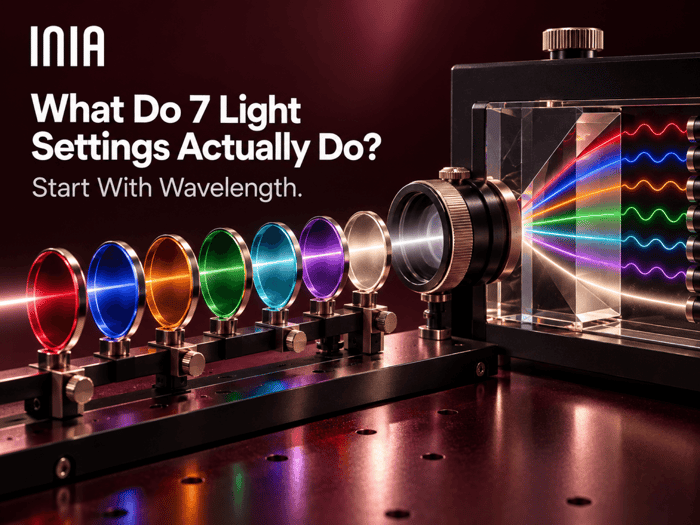
Glokore offers seven light settings in a wireless, hands-free mask. Its public information does not identify the exact wavelength behind each setting, the irradiance at the skin, or the energy delivered during a session. Those details are essential because different wavelengths work through different optical and biological pathways.
Table of Contents
Why Glokore’s Seven-Light Design Gets Attention
Seven light settings sound versatile. A shopper can reasonably expect each color to serve a different skin goal. The wireless design also makes the mask easier to fit into a normal routine.
The number of colors does not explain what the mask delivers. “Red,” “blue,” or “yellow” describes a color range. It does not identify the exact wavelength, light intensity at the skin, or energy delivered during a session.
The useful question is simple: What is each light setting designed to do, and which wavelength produces that interaction?
Why Different LED Wavelengths Have Different Roles
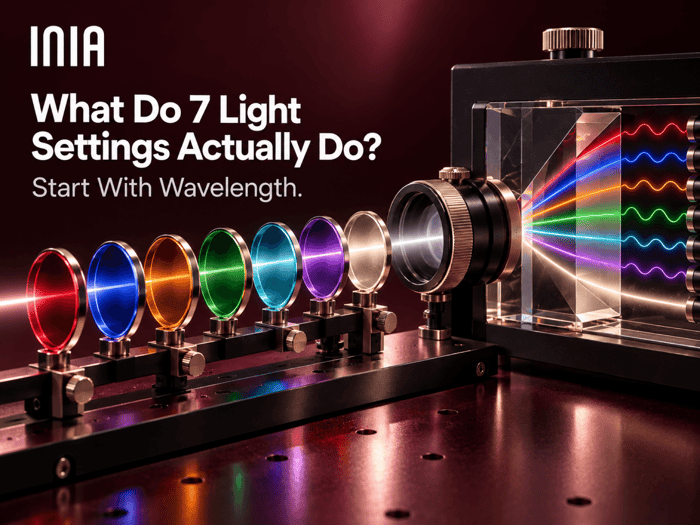
Skin contains light-absorbing targets called chromophores. Wavelength affects which chromophores absorb the light and how far the light travels through tissue. Dose and exposure time determine the amount delivered.
| Light range | Research-based principle | Meaning for an LED mask |
|---|---|---|
| Blue light | Blue wavelengths interact with porphyrins associated with Cutibacterium acnes. Absorption is strongest in the blue-violet range. | A blemish-focused mode needs a disclosed wavelength and controlled exposure. |
| 590nm amber light | Research has examined 590nm light in relation to visible redness, pigmentation, and skin-barrier responses. | A brightening or soothing routine needs a defined wavelength and schedule. |
| 630nm red light | Red light interacts with cellular chromophores, including cytochrome c oxidase, and initiates downstream signaling. | Red light commonly forms the basis of skin-rejuvenation protocols. |
| 850nm and 940nm NIR | Near-infrared light travels beyond the more superficial reach of shorter visible wavelengths. Its interactions vary with wavelength, tissue, and dose. | NIR adds another optical layer to a wavelength-based routine. |
Research does not support treating every color as interchangeable or judging a device by color count alone. A complete protocol records wavelength, irradiance, delivered energy or fluence, exposure time, and treatment schedule (Jenkins and Carroll, 2011; Jagdeo et al., 2018).
Blue-light research shows why precision matters. Two products labeled “blue” can use different wavelengths and should not automatically be treated as equivalent (Coates et al., 2024).
How INIA Applies Wavelength Science in GLOW 4D
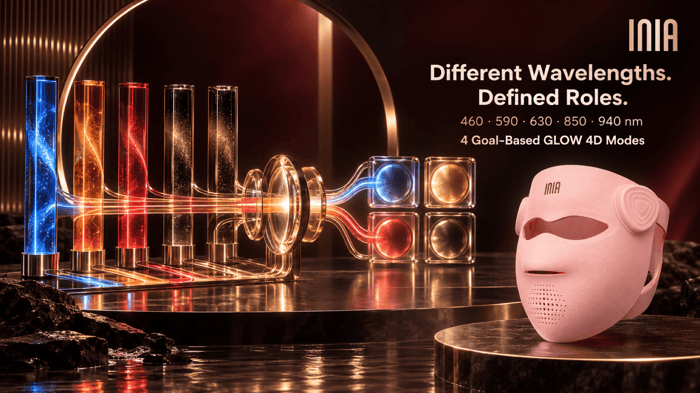
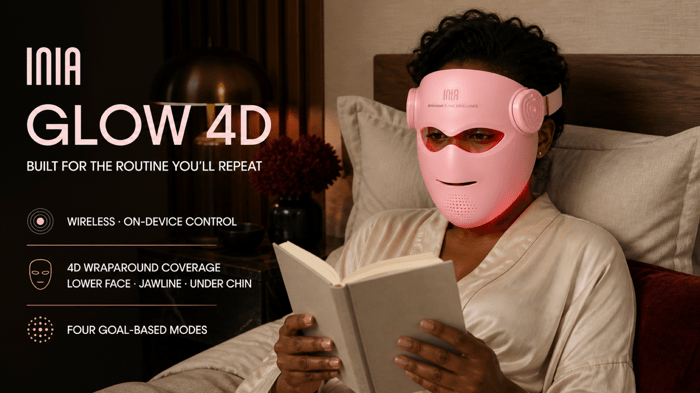
Glokore presents seven light settings without identifying the exact wavelength and light-delivery protocol behind each one. INIA applies the wavelength principles above in the GLOW 4D Wireless LED Light Therapy Mask, organizing five disclosed wavelengths into four goal-based routines.
GLOW 4D uses 460nm blue, 590nm amber, 630nm red, 850nm NIR, and 940nm NIR. Dual NIR can be switched on or off for a session.
| GLOW 4D mode | Wavelength combination | Mixed-mode irradiance | Recommended time |
|---|---|---|---|
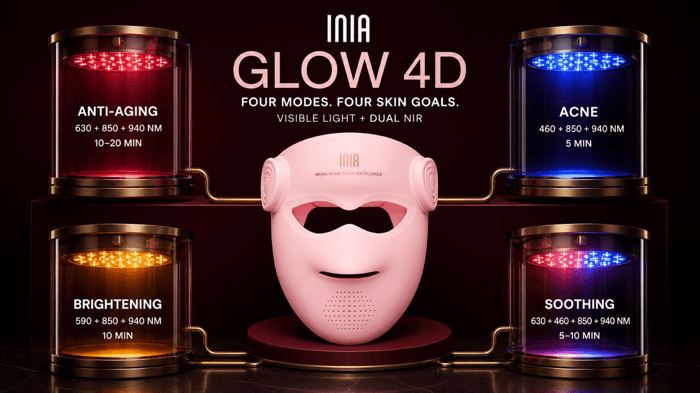
| Anti-Aging | 630nm red + 850nm NIR + 940nm NIR | 18.5 mW/cm², ±10% | 10–20 minutes |
| Acne | 460nm blue + 850nm NIR + 940nm NIR | 29.0 mW/cm², ±10% | 5 minutes |
| Brightening | 590nm amber + 850nm NIR + 940nm NIR | 17.0 mW/cm², ±10% | 10 minutes |
| Soothing | 630nm red + 460nm blue + 850nm NIR + 940nm NIR | 35.0 mW/cm², ±10% | 5–10 minutes |
The mode name identifies the starting goal, the wavelength combination explains the light selection, and the recommended time defines the routine. Dual 850nm and 940nm NIR is active by default and can be switched off or back on with the control.
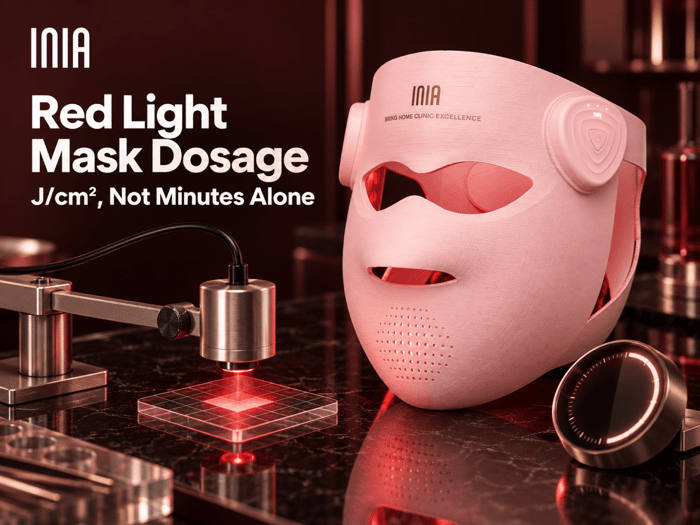
GLOW 4D documents a device-level energy range of 3–15 J/cm² and an array of 80 LED beads with four chips per bead, for 320 light chips. Together, the wavelength, timing, dose-range, and array information create a clear technical framework for the four routines.
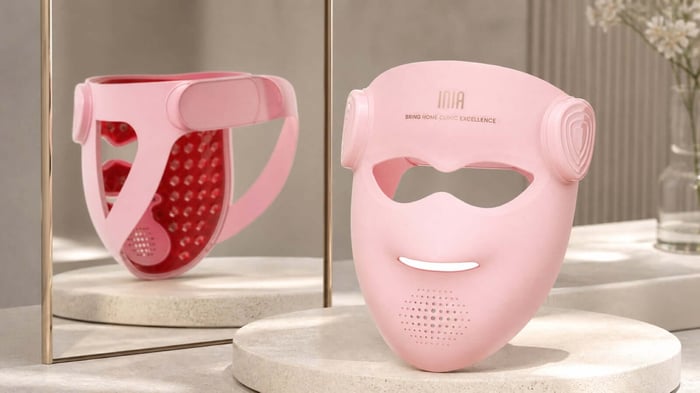
GLOW 4D is wireless, and its flexible mask extends around the jawline and under the chin. Magnetic under-eye cooling pads support comfort during use. These features make the wavelength-based routines easier to incorporate into regular skincare.
For more help matching a wavelength to a visible skin goal, read which LED light therapy color is best for skin.
Look Beyond the Number of Light Colors
Glokore’s main appeal is clear: seven light settings in a convenient wireless mask. Its public information does not connect those settings to exact wavelengths and a defined light-delivery protocol.
INIA GLOW 4D organizes five disclosed wavelengths into four named routines and documents session times, a device-level dose range, and light-array construction. It is the better-documented choice for shoppers who want to understand the technology behind each mode.
Frequently Asked Questions
Do seven LED colors make a mask more effective?
No. Color count shows how many options are available. Effectiveness depends on exact wavelengths, irradiance, delivered energy, exposure time, treatment schedule, fit, and consistency of use.
Why does the exact wavelength matter?
Different wavelengths interact with different chromophores and reach different optical depths. An exact nanometer value allows a product setting to be compared with relevant research.
What information should an LED mask publish?
Look for exact wavelengths, irradiance, energy delivered per session, exposure time, treatment schedule, mode design, and light-array construction.
How does GLOW 4D turn wavelength science into a practical routine?
GLOW 4D groups five disclosed wavelengths into four goal-based modes with defined session times. Its wireless format, flexible lower-face coverage, optional dual NIR, and magnetic cooling pads support consistent use.
How is the GLOW 4D light array constructed?
The array uses 80 LED beads with four light chips in each bead, for 320 light chips across the mask.
What is the GLOW 4D energy range?
GLOW 4D documents a device-level energy range of 3–15 J/cm² alongside its wavelength, session-time, and array information.
References
- Jenkins, P. A., & Carroll, J. D. (2011). How to Report Low-Level Laser Therapy/Photomedicine Dose and Beam Parameters in Clinical and Laboratory Studies. Photomedicine and Laser Surgery.
- Jagdeo, J., et al. (2018). Light-Emitting Diodes in Dermatology: A Systematic Review of Randomized Controlled Trials. Lasers in Surgery and Medicine.
- Austin, E., et al. (2021). Visible Light Part I: Properties and Cutaneous Effects of Visible Light. Journal of the American Academy of Dermatology.
- Coates, M., et al. (2024). Illuminating Microflora: The Potential of Blue Light to Modulate the Cutaneous Microbiome. Frontiers in Cellular and Infection Microbiology.
- Zhang, Y., et al. (2022). 590nm LED Irradiation and Skin Responses. Photodermatology, Photoimmunology & Photomedicine.
- INIA GLOW 4D Wireless LED Light Therapy Mask