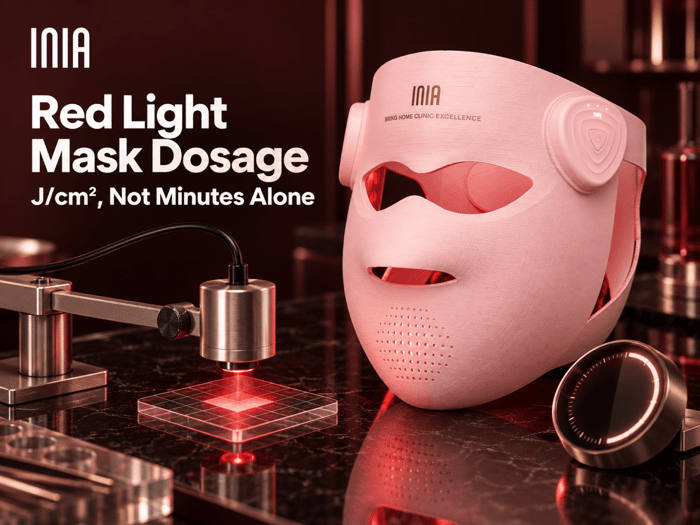
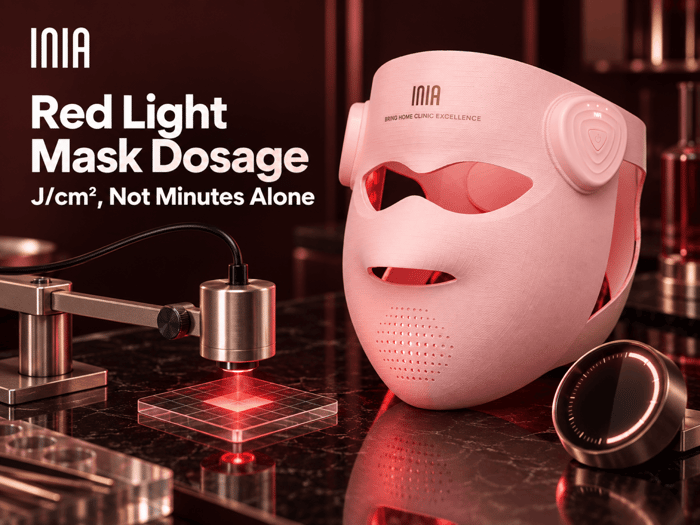
Red light therapy mask dosage is the light energy delivered to each square centimeter of skin—not simply how long you wear the mask. It is commonly expressed in joules per square centimeter (J/cm²). Because masks differ in output, there is no universal minute setting.
Table of Contents
What Does “Dose” Mean for a Red Light Mask?
In photobiomodulation research, a session is not described by time alone. Researchers report wavelength, irradiance at the skin, exposure time, treatment area, number of sessions, and the interval between them.1
| Term | What it tells you | Common unit |
|---|---|---|
| Wavelength | The type of light being delivered | Nanometers (nm) |
| Irradiance | How much optical power reaches a unit of skin at one moment | mW/cm² |
| Exposure time | How long that irradiance is applied | Seconds or minutes |
| Radiant exposure | The calculated energy delivered per unit area during one session | J/cm² |
| Treatment schedule | How often the session is repeated and for how many weeks | Sessions per week |
The “right dose” therefore needs both irradiance and time, followed by a repeatable weekly schedule.
How to Calculate a Red Light Mask Session Dose
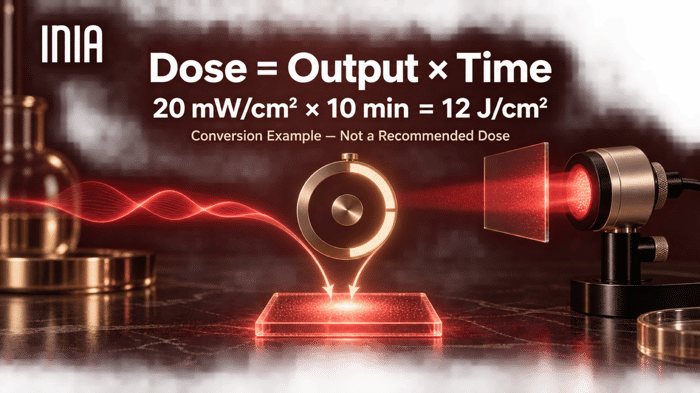
Radiant exposure (J/cm²) = irradiance (mW/cm²) × time (seconds) ÷ 1,000
First convert minutes into seconds. Then multiply the device’s irradiance by those seconds and divide by 1,000. For example, a mask delivering 20 mW/cm² for 10 minutes would provide a calculated surface dose of 12 J/cm²: 20 × 600 ÷ 1,000 = 12. This is a conversion example, not a recommended dose.
The calculation estimates energy arriving at the surface, not energy absorbed by a specific skin layer. Distance, fit, facial curves, LED spacing, and wavelength affect delivery. Two protocols are not automatically interchangeable: different irradiances can produce different responses even when calculated J/cm² is equal.2
Why 10 Minutes on One Mask Is Not 10 Minutes on Another
Doubling time approximately doubles calculated radiant exposure only when irradiance stays the same. If Mask A delivers 10 mW/cm² and Mask B delivers 30 mW/cm², ten minutes on Mask B represents three times the incident energy.
Copying a routine from another mask or panel is therefore unreliable. “More” is not automatically better: photobiomodulation can have a biphasic response, in which too little has limited effect but exposure beyond the useful window may also reduce the response.2
What Human Mask Research Actually Tells Us About Dose
A 2025 randomized, double-blind, sham-controlled facial study used 630nm red and 850nm near-infrared light at a reported maximum output of 10 mW/cm² for each wavelength. Participants completed nine-minute sessions five times weekly for 12 weeks.3
The active group’s crow’s-feet scores differed from the sham group from week eight. The dosage lesson is not “use every mask for nine minutes.” The result belonged to the complete protocol: wavelength, output, session time, frequency, and duration.
How to Dose Your Red Light Mask in Practice
- Use the schedule for your exact device. Do not import minutes from a mask with a different output.
- Keep the fit consistent. Position the mask the same way each session.
- Track frequency as well as time. Ten minutes once a week and ten minutes five times a week are different treatment courses.
- Do not stack treatments to “make up” missed sessions. Resume the normal schedule.
- Change one variable at a time. If the instructions allow a gradual increase, adjust either duration or frequency—not both at once.
If irradiance is published, use the formula to understand the stated session. If not, follow the specified time and frequency rather than guessing a J/cm² value.
How INIA GLOW 4D Makes the Dose Repeatable
The INIA GLOW 4D Wireless LED Light Therapy Mask turns dosage into a device-specific routine. Based on INIA’s technical specifications, its recommended 10–20-minute Red + NIR session corresponds to a calculated nominal surface dose of approximately 11.1–22.2 J/cm².
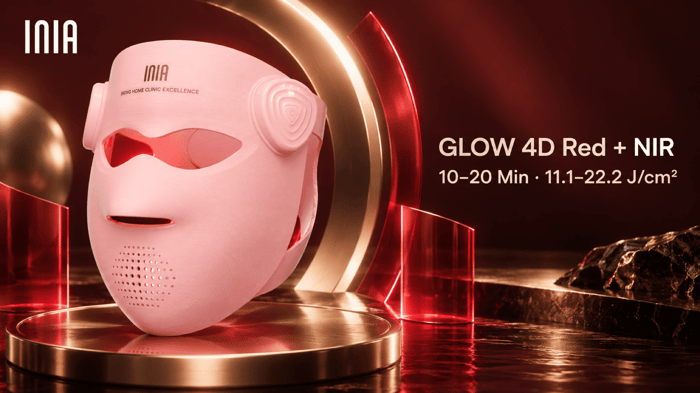
Use the lower end of the prescribed session range when beginning or following sensitivity guidance, and increase only as directed. Its 4D wraparound shape extends coverage toward the chin and jawline, while wireless use supports consistency. These features do not justify extending the session or copying another device’s dose.
For preparation, fit, skincare order, and cleaning, follow the complete guide to using red light therapy on your face.
When to Reduce Exposure or Ask a Clinician
Follow the eye-protection, duration, and frequency instructions supplied with your device. Ask a clinician before use if you have a light-sensitive condition, take photosensitizing medication, or are treating a diagnosed skin condition.4
Stop and reassess if you experience eye pain, burning, persistent redness, or uncomfortable heat. Do not extend the session simply because results are gradual.
Dose Is a Complete Protocol, Not a Minute Count
J/cm² converts device output and treatment time into one understandable session dose, but a useful protocol still includes wavelength, fit, frequency, and consistency. Follow the dose and schedule designed for your exact mask instead of copying another device’s minutes.
Frequently Asked Questions
What is the dosage formula for a red light mask?
Radiant exposure in J/cm² equals irradiance in mW/cm² multiplied by time in seconds, divided by 1,000. The result is an estimate of incident energy at the surface, not the amount absorbed by deeper tissue.
How many minutes should I use a red light mask?
Use the session time specified for your exact device. Minutes cannot be transferred reliably between masks because irradiance, wavelength, fit, and treatment design differ.
Can I use a red light mask longer for faster results?
Not necessarily. More exposure is not automatically more effective, and photobiomodulation can have a biphasic dose response. Follow the device protocol instead of adding time.
Does a higher irradiance mean a better mask?
No. Irradiance helps determine dose, but wavelength, session design, coverage, fit, and repeatability also matter. Higher output without an appropriate protocol is not inherently better.
References
- Jenkins PA, Carroll JD. How to report low-level laser therapy/photomedicine dose and beam parameters in clinical and laboratory studies. Photomedicine and Laser Surgery. 2011;29(12):785–787.
- Huang YY, et al. Biphasic dose response in low level light therapy—an update. Dose-Response. 2011;9(4):602–618.
- Park SH, Park SO, Jung JA. Clinical study to evaluate the efficacy and safety of home-used LED and IRED mask for crow’s feet. Medicine. 2025;104(7):e41596.
- American Academy of Dermatology. Is red light therapy right for your skin?
- INIA. GLOW 4D Wireless LED Light Therapy Mask.