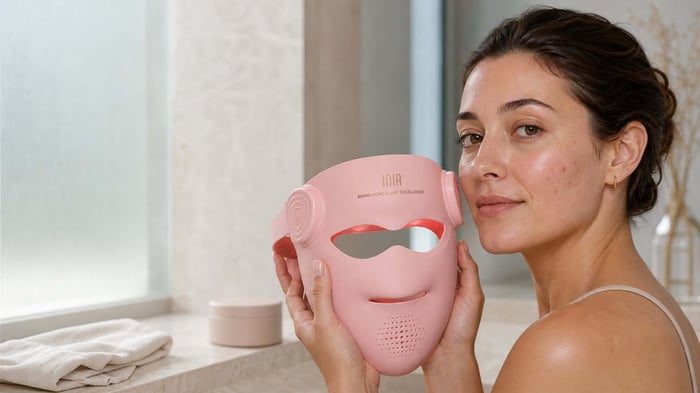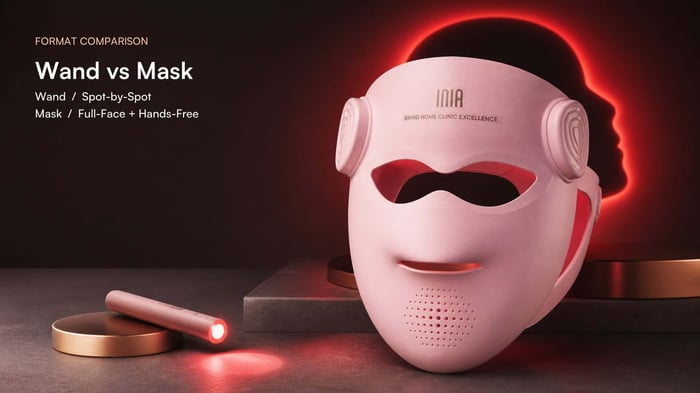

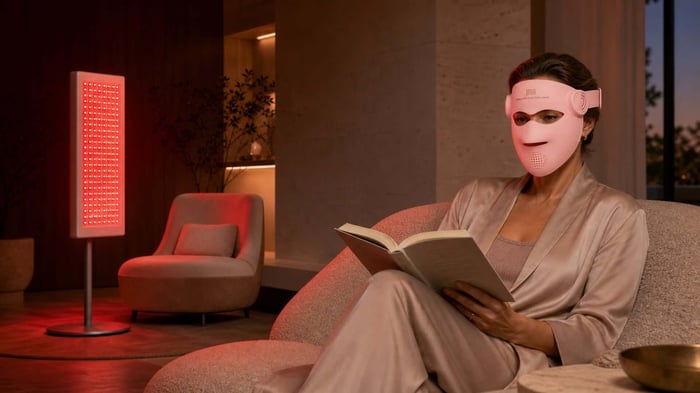
Red light masks and panels use the same core technology for different treatment areas. Masks have become the practical, clinically studied format for facial skin; panels extend red and near-infrared light to larger areas of the body.
Choose a mask when your goal is facial skin appearance and a repeatable hands-free routine. Choose a panel when you want broader coverage beyond the face. The format changes where the light can be delivered—not whether red light itself can work.
Table of Contents
One red light therapy, two ways to deliver it
Red light therapy, also called photobiomodulation, uses specific red and near-infrared wavelengths to produce biological responses without intentionally damaging the skin. A face mask and a panel do not create two different therapies. They package and position the light differently.
A mask shapes the light source around the face. A panel places a larger light source at a stated distance from the body. This changes coverage, positioning, and the routine required from the user.
Red light for facial skin
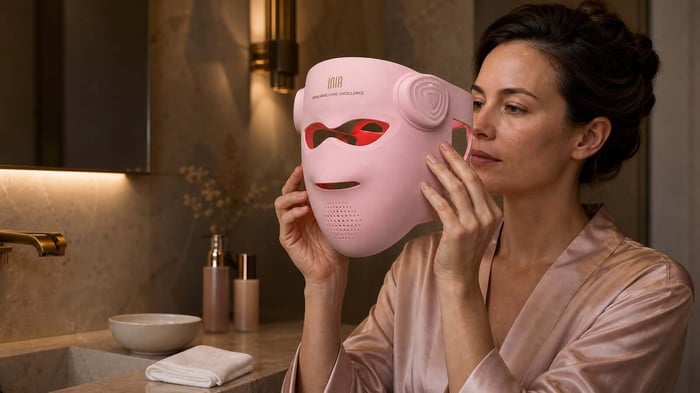
Designed around facial contours so red and near-infrared light can become a consistent, hands-free skincare routine.
Red light for larger areas
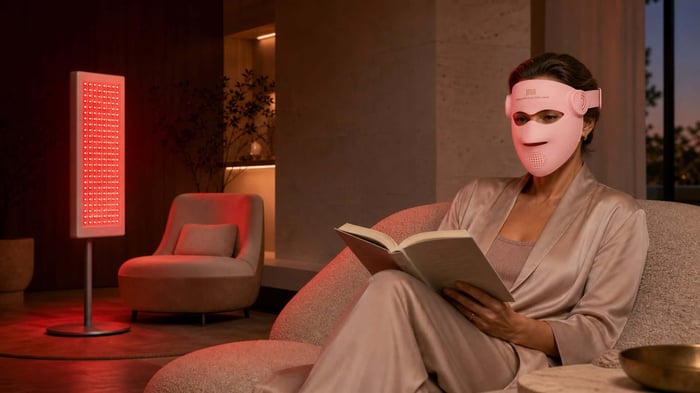
Uses a larger emitting surface to bring red and near-infrared light to the neck, chest, back, arms, legs, or multiple body areas.
What red light masks have shown for facial skin
Facial rejuvenation is one of the clearest reasons consumers choose a red light mask. Clinical research has evaluated changes in fine lines, wrinkles, skin roughness, and collagen-related measures after repeated red and near-infrared light exposure.
A 2025 randomized, double-blind, sham-controlled trial studied 60 adults using a home LED mask with 630 nm red light and 850 nm near-infrared light. Participants used the active or sham device for nine minutes, five times a week. Independent assessments found significant differences between the groups at eight, 12, and 16 weeks; at week 12, 86.2% of the active-device group showed improvement in crow’s-feet grading, compared with 16.7% of the control group.1
An earlier randomized controlled trial of 136 participants found that repeated red and near-infrared light treatment improved fine lines, wrinkles, skin roughness, and intradermal collagen density compared with control treatment.2 A systematic review of randomized trials also identified clinical evidence for LED-based skin rejuvenation, while noting that devices and treatment protocols varied across studies.3
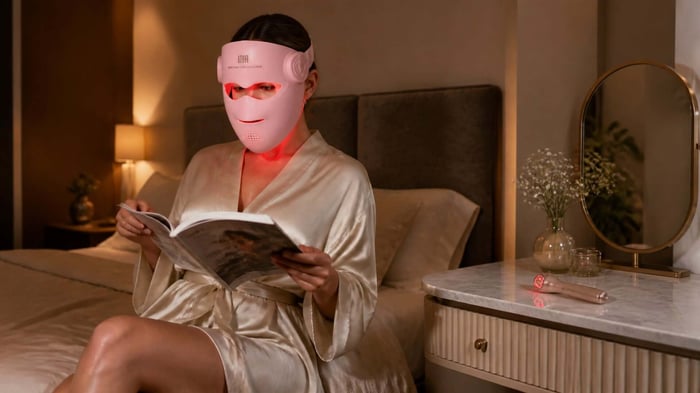
How panels take red light beyond the face
The panel is not a replacement for the facial evidence behind red light. It is the format that makes the same category of light practical across larger areas.
That wider coverage opens different use cases. Large-area red and near-infrared treatment has been studied for skin appearance beyond one small facial zone,2 and localized photobiomodulation has also been investigated around exercise and muscle recovery. A 2024 meta-analysis of 34 randomized trials found modest improvements in muscle endurance and recovery measures, although results differed by activity level and treatment protocol.4
This does not mean that every red light panel improves every body concern. It means a panel provides the coverage needed to apply red and near-infrared light outside the face. The expected benefit still has to match the evidence, dose, and instructions for that exact use.
See why one user would keep the panel
Creator perspective: This video features an INIA product and reflects one creator’s personal routine and preference. It is not clinical evidence that a panel is more effective than a mask, and individual experiences may vary.
From a beauty routine to a body routine
Toni says she still loves her mask for facial skincare, but she would keep GLOW FLEX if she could choose only one device because she can also position it around her neck, shoulders, back, and legs. Her example makes the format difference tangible: a mask specializes in the face, while a panel extends the possible treatment area.
Open the original TikTok video
Explore INIA GLOW FLEX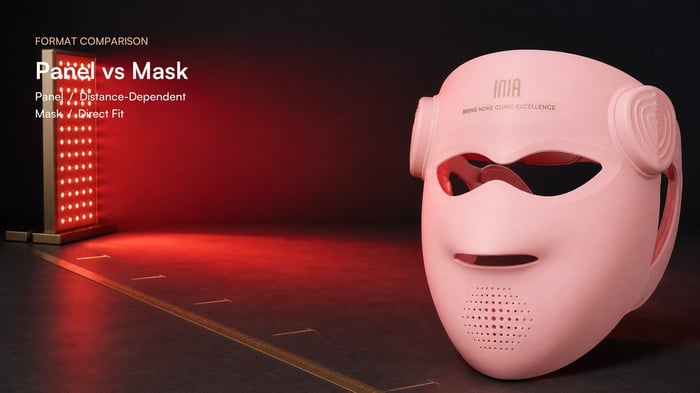
Moving from face to body changes the setup
A face mask keeps the LEDs close to a defined facial area. With a panel, the user has to reproduce the manufacturer’s stated distance and angle. Moving farther away can change both irradiance and the size of the illuminated area.
That is why panel output cannot be judged from total wattage or LED count alone. Scientific reporting guidance treats wavelength, irradiance at the target, exposure time, beam area, and treatment geometry as essential parts of the dose.56
Red light panel vs. mask comparison
| Decision factor | LED face mask | Red light panel |
|---|---|---|
| Primary role | Facial skincare | Extending red light to larger body areas |
| Typical coverage | Face, depending on mask fit and contour | Face, neck, chest, back, arms, or legs, depending on panel size |
| Positioning | Defined mainly by the mask’s shape and straps | Defined by the instructed distance, angle, and body position |
| Routine | Wearable and hands-free | Requires sitting or standing in front of the light |
| Best choice when | Your goal is facial skin appearance | Your goal genuinely includes areas beyond the face |
If you only want to improve the appearance of facial skin, a mask is the more direct tool. A panel becomes useful when larger body coverage is itself the reason for buying a device—not simply because the panel looks more powerful.
Where INIA GLOW 4D fits
INIA GLOW 4D belongs on the facial side of this red light evolution. It takes red and near-infrared light and builds the delivery system around facial coverage and repeatable home use.
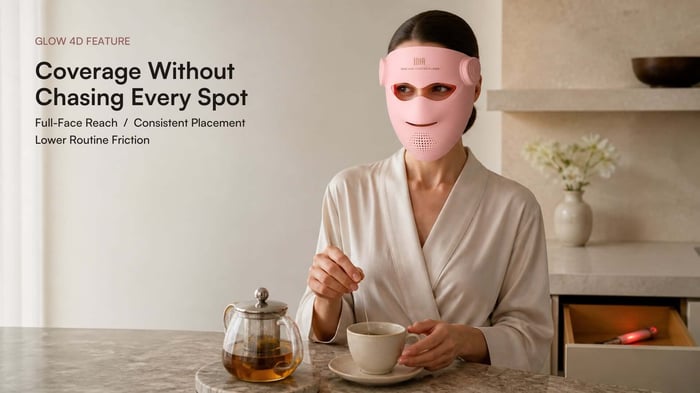
The current product page lists a wireless design, a 4D contour that extends around the jawline and chin, dual 850 nm and 940 nm near-infrared light, and four LED modes. These are practical facial-use features: they help define where the light goes and how the mask fits into a routine.
For more help comparing facial devices, read our red light therapy mask review guide. Once you have chosen a mask, follow the complete routine in our guide to using red light therapy before or after skincare.
Explore INIA GLOW 4DMasks established the facial routine; panels expand the coverage
Red light masks have made clinically studied facial photobiomodulation practical at home. Red light panels carry the same core technology into a larger format, allowing it to reach areas that a face mask cannot cover.
Choose by the problem you want to solve: a mask for facial skin appearance, or a panel when your intended use genuinely extends to the body. Then follow the evidence and instructions for the exact device and goal.
Explore INIA GLOW 4D for facial red light therapyFrequently Asked Questions
Is a red light panel better than a mask?
Not for every goal. A mask is purpose-built for facial skincare, while a panel is useful when you want red and near-infrared light across larger body areas.
Do red light masks have clinical evidence?
Yes. Randomized controlled trials have reported improvements in facial wrinkles and other skin-rejuvenation measures with specific red and near-infrared devices and protocols. Those findings should not be generalized to every mask regardless of specifications.
Can a red light panel provide facial skin benefits?
It can be used for the face when the exact panel instructions support facial use. A mask may still be easier to position consistently because it is designed around facial contours.
What are red light panels used for on the body?
Panels provide the coverage needed to apply red and near-infrared light to larger skin and muscle areas. The expected benefit and treatment schedule depend on the specific body goal and the evidence and instructions for the device.
References
- Park SH, Park SO, Jung JA. Clinical study to evaluate the efficacy and safety of home-used LED and IRED mask for crow’s feet: A multi-center, randomized, double-blind, sham-controlled study. Medicine. 2025;104(7):e41596. doi:10.1097/MD.0000000000041596.
- Wunsch A, Matuschka K. A Controlled Trial to Determine the Efficacy of Red and Near-Infrared Light Treatment in Patient Satisfaction, Reduction of Fine Lines, Wrinkles, Skin Roughness, and Intradermal Collagen Density Increase. Photomedicine and Laser Surgery. 2014;32(2):93–100. doi:10.1089/pho.2013.3616.
- Jagdeo J, et al. Light-emitting diodes in dermatology: A systematic review of randomized controlled trials. Lasers in Surgery and Medicine. 2018;50(6):613–628. doi:10.1002/lsm.22791.
- Li BM, et al. Can pre-exercise photobiomodulation improve muscle endurance and promote recovery from muscle strength and injuries in people with different activity levels? A meta-analysis of randomized controlled trials. Lasers in Medical Science. 2024;39(1):132. doi:10.1007/s10103-024-04079-y.
- Jenkins PA, Carroll JD. How to Report Low-Level Laser Therapy (LLLT)/Photomedicine Dose and Beam Parameters in Clinical and Laboratory Studies. Photomedicine and Laser Surgery. 2011;29(12):785–787. doi:10.1089/pho.2011.9895.
- Hadis MA, et al. The dark art of light measurement: accurate radiometry for low-level light therapy. Lasers in Medical Science. 2016;31(4):789–809. doi:10.1007/s10103-016-1914-y.
- INIA. INIA GLOW 4D 940nm Dual NIR Wireless LED Mask. Official product page. Accessed August 21, 2026.