

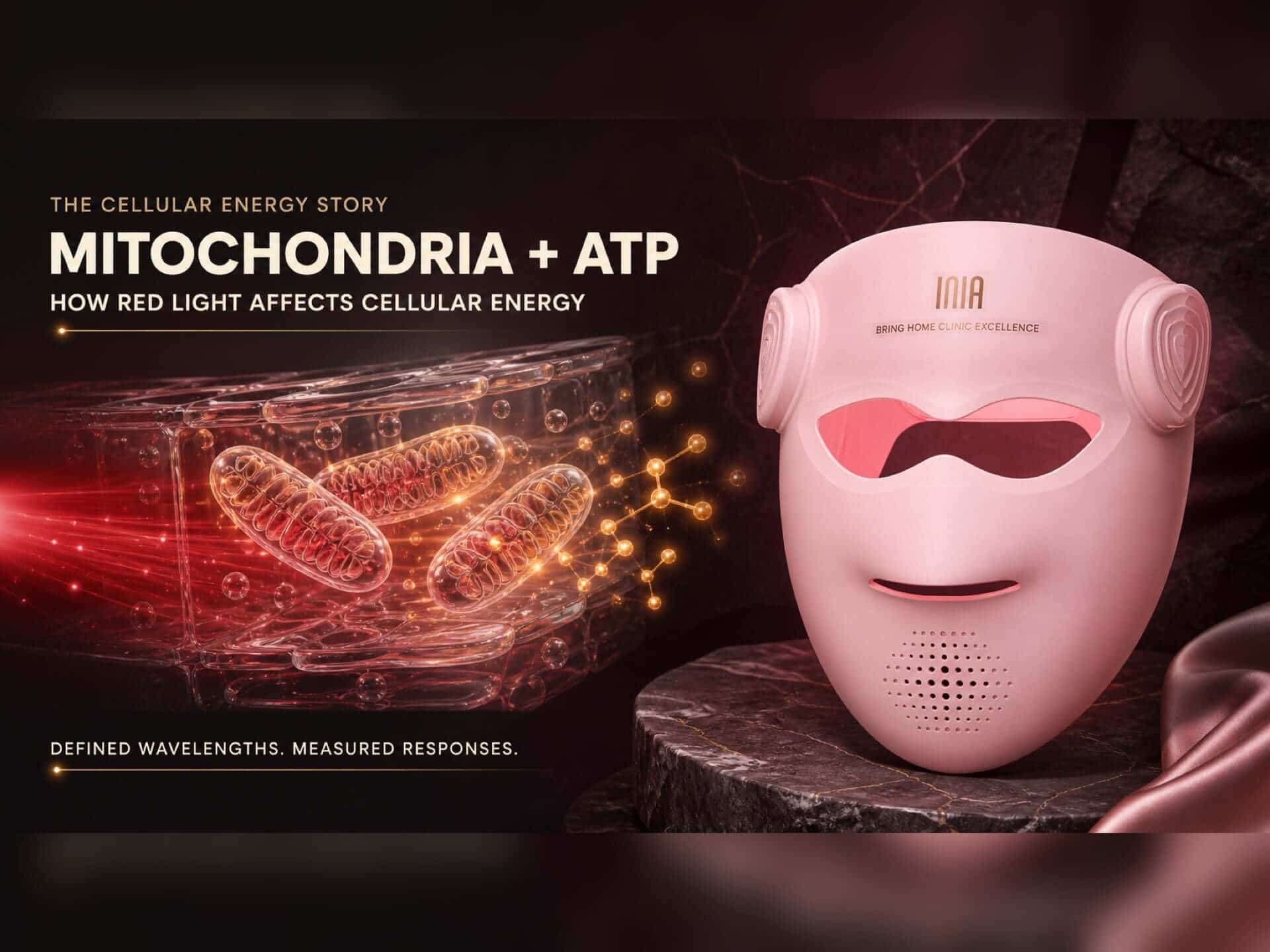

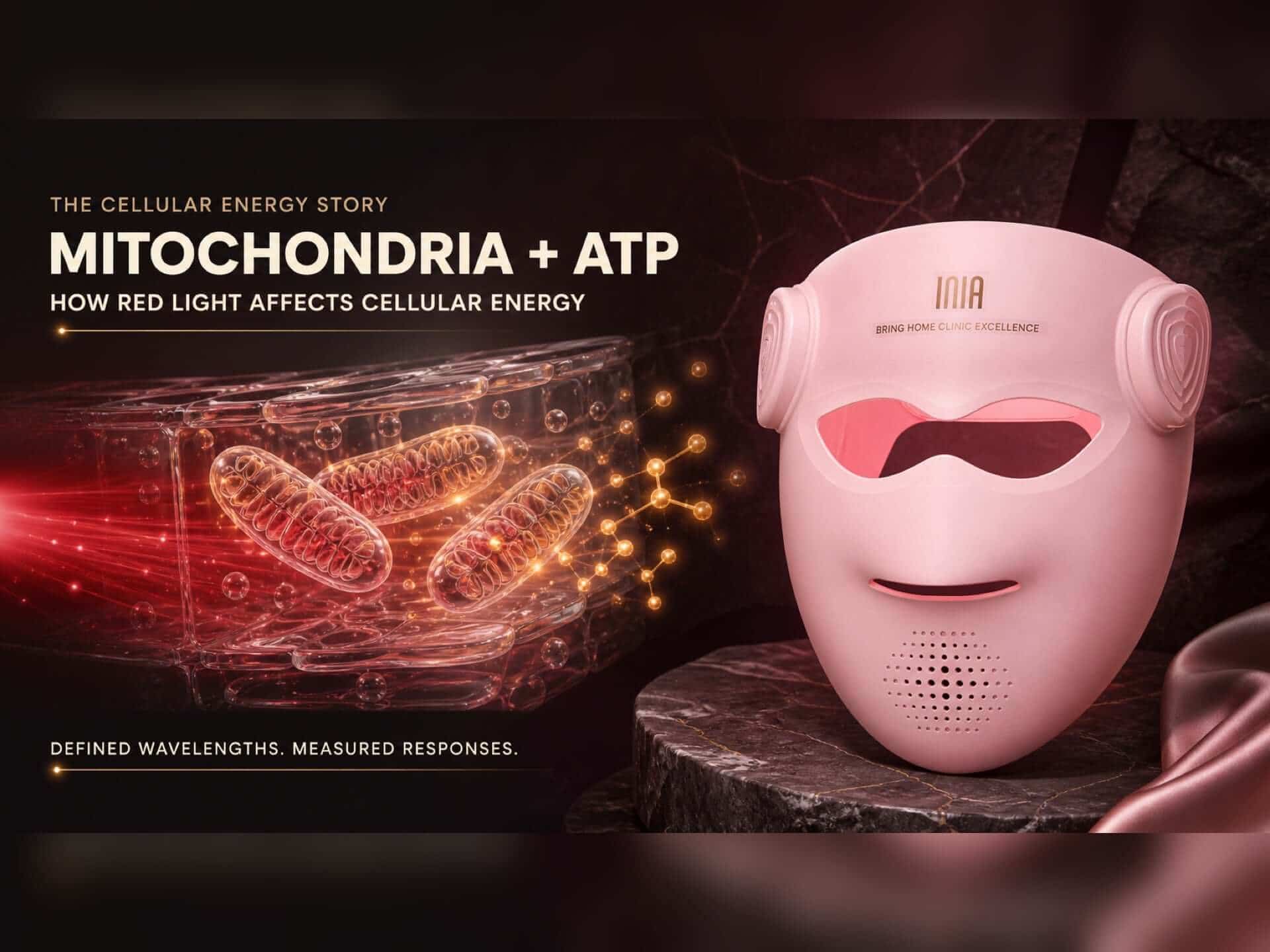
Red light therapy works through photobiomodulation. Red and near-infrared light interact with light-sensitive molecules in cells, changing mitochondrial energy production and cellular signaling. That response supports fibroblast activity, collagen production, and the gradual remodeling of skin.
Table of Contents
How Does Red Light Reach the Mitochondria?
Mitochondria are the energy centers inside cells. They convert nutrients and oxygen into adenosine triphosphate, or ATP—the usable energy that powers cellular work.
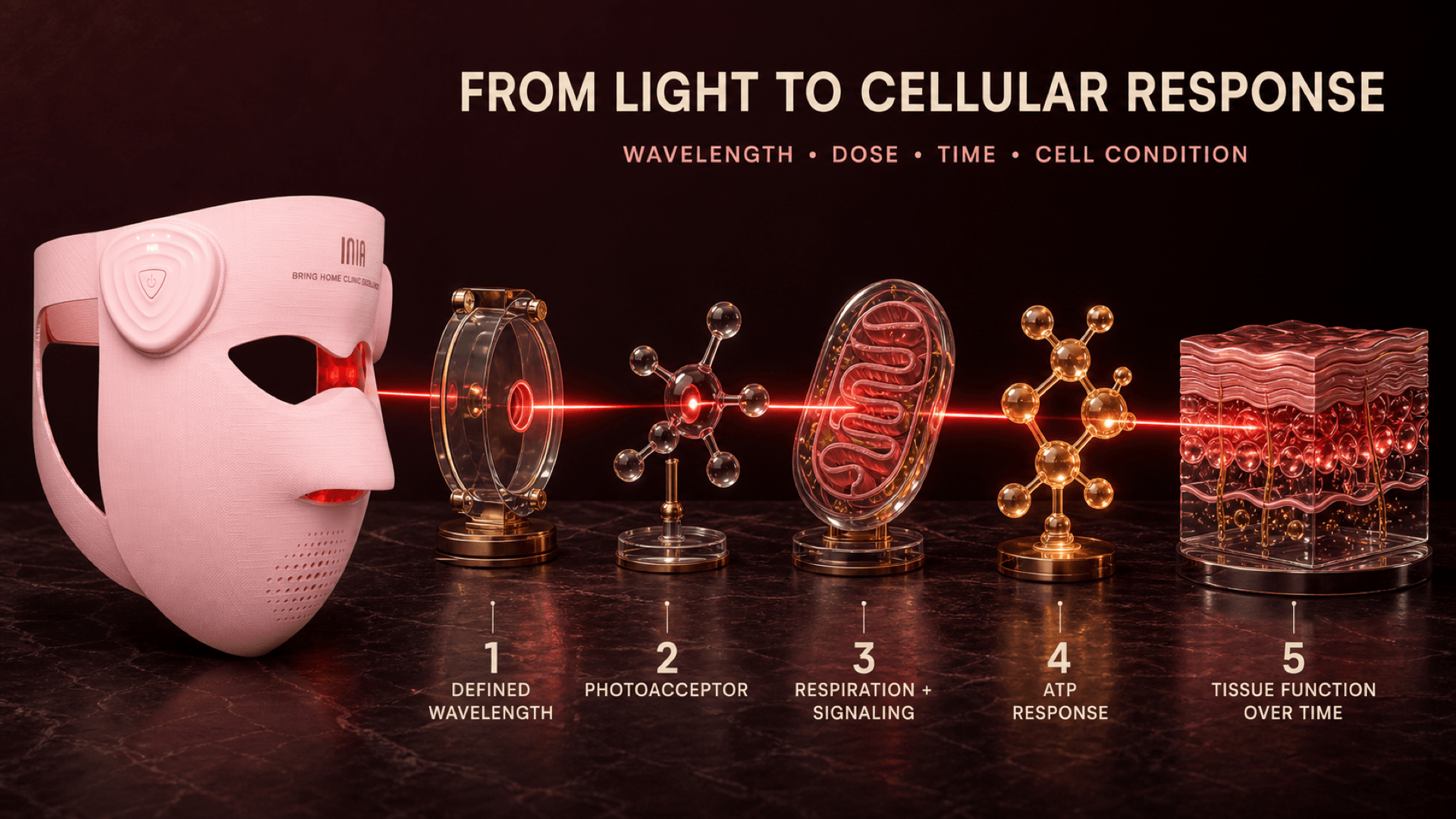
Red and near-infrared photons can pass into skin and be absorbed by cellular photoacceptors. One of the best-studied is cytochrome c oxidase, an enzyme in the mitochondrial electron transport chain. Light absorption changes electron transport and affects ATP, reactive oxygen species, calcium, and nitric-oxide signaling.1
This is photobiomodulation: light does not heat or damage the skin to force a repair response. It changes how cells produce energy and communicate.
How Does ATP Connect to Collagen?
ATP does not become collagen. It supplies energy for the cellular work behind skin renewal and protein production.
The same photobiomodulation response also changes redox, calcium, and nitric-oxide signaling. Together, energy and signaling influence how cells proliferate, migrate, and make proteins.1
That matters because dermal fibroblasts make collagen and help maintain the extracellular matrix that gives skin structure. Controlled laboratory research in human fibroblasts has measured wavelength-dependent changes in mitochondrial membrane potential and redox balance after LED exposure.2
What Do Human Skin Studies Show?
The cellular mechanism matters because human studies have also measured changes in skin—not only changes in a laboratory dish.
In a randomized, double-blind, placebo-controlled split-face study, 76 people with facial wrinkles received 633nm red light, 830nm near-infrared light, a combination of both, or sham treatment twice weekly for four weeks. Active groups showed reduced wrinkle measurements and improved elasticity. Skin samples also showed more collagen and elastic fibers, with activated fibroblasts surrounded by new matrix fibers.3
The study does not prove that every red-light device performs the same way. It shows that a defined wavelength and treatment protocol can carry the cellular mechanism through to measurable skin changes.
What Makes Red Light Therapy Effective at Home?
The mechanism only becomes useful when a device delivers it as a repeatable routine. Four factors matter:
Defined Light
- Wavelengths: tell you which light is being delivered.
- Session time: keeps exposure inside a stated protocol.
Repeatable Use
- Coverage: keeps the intended skin area within the light field.
- Consistency: gives cells repeated exposure over time.
More minutes are not automatically better. Photobiomodulation follows a dose response, so wavelength, output, timing, and frequency work as one system.1
How INIA GLOW 4D Applies the Science
INIA designed GLOW 4D to turn the mitochondrial science of red and near-infrared light into a defined anti-aging routine.
Its Anti-Aging Mode combines 630nm red light with 850nm and 940nm dual near-infrared light in a 10–20 minute session. The flexible 4D shape extends across the face, jawline, lower face, and under-chin area. Wireless operation makes it easier to complete the routine consistently.
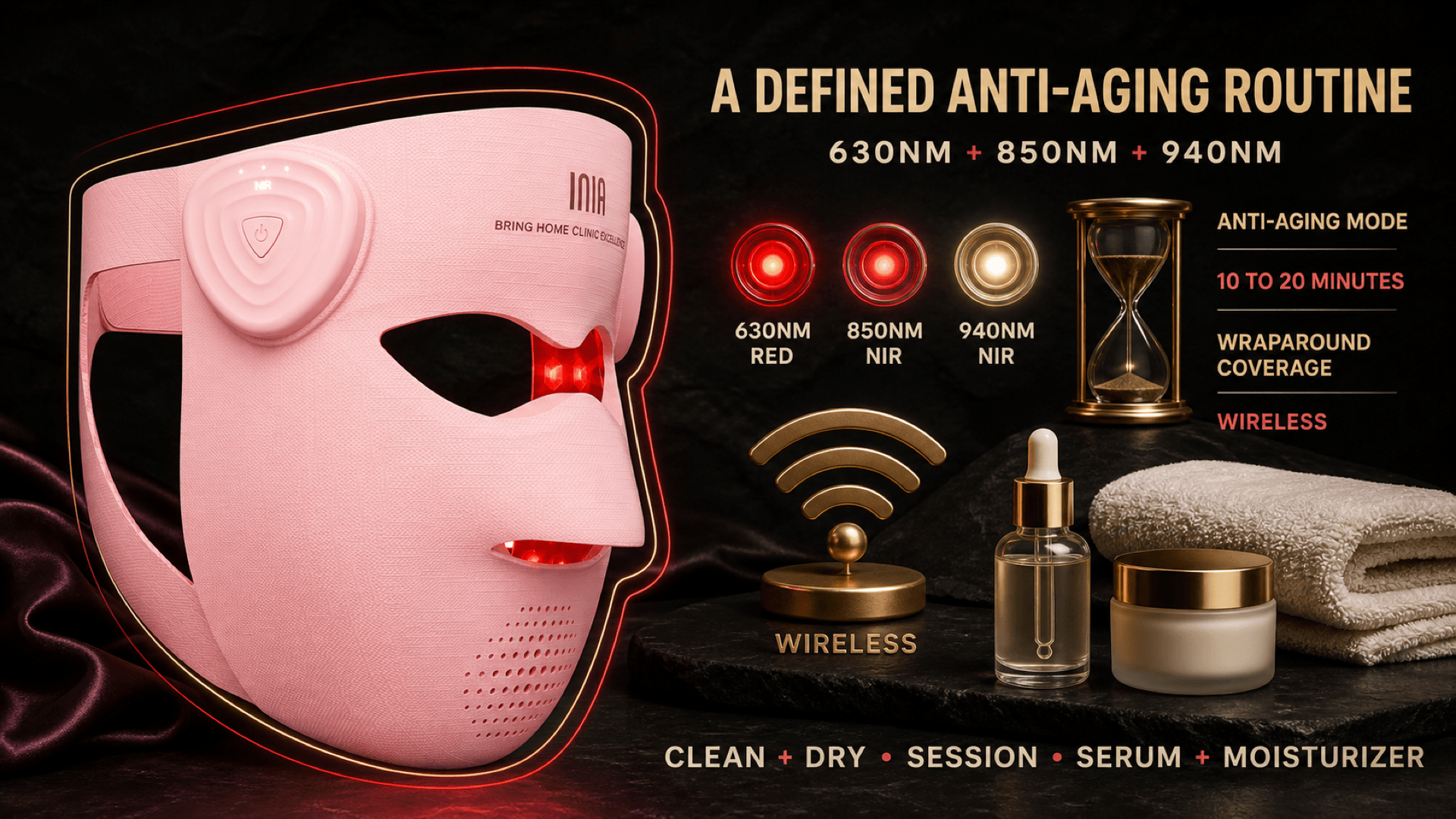
GLOW 4D also includes Acne, Brightening, and Soothing modes, plus magnetic under-eye cooling pads. The value is not simply that the mask emits light. It turns different light combinations into clear routines for changing skin goals.
Red Light Works Through Cellular Energy and Signaling
Red and near-infrared light act on mitochondrial energy metabolism and cellular signaling. That response supports fibroblasts, collagen synthesis, and the remodeling that improves how skin looks and feels over time.
GLOW 4D turns that science into a usable home system: defined red and dual-NIR wavelengths, a stated session, wraparound coverage, and a design made for repeatable use.
Frequently Asked Questions
How does red light therapy affect mitochondria?
Red and near-infrared photons interact with cellular photoacceptors, including cytochrome c oxidase. This changes mitochondrial electron transport, ATP metabolism, and cellular signaling.
Does ATP turn into collagen?
No. ATP provides energy for cellular work. Fibroblasts use energy and molecular signals to synthesize collagen and maintain the skin's extracellular matrix.
How long does red light therapy take to support skin changes?
Skin changes build through repeated sessions. In one randomized facial study, participants completed two sessions per week for four weeks, followed by further observation. Follow the routine stated for your device.
Why does GLOW 4D combine red and near-infrared light?
Both red and near-infrared wavelengths are used in photobiomodulation research. GLOW 4D combines 630nm red with 850nm and 940nm dual NIR in one defined Anti-Aging Mode.
References
- Maghfour, J., et al. (2024). Photobiomodulation CME part I: Overview and mechanism of action. Journal of the American Academy of Dermatology, 91(5), 793–802.
- Baldassarro, V. A., et al. (2023). Photobiomodulation at Defined Wavelengths Regulates Mitochondrial Membrane Potential and Redox Balance in Skin Fibroblasts. Oxidative Medicine and Cellular Longevity, 2023, 7638223.
- Lee, S. Y., et al. (2007). A prospective, randomized, placebo-controlled, double-blinded, split-face clinical study on LED phototherapy for skin rejuvenation. Journal of Photochemistry and Photobiology B, 88(1), 51–67.
- INIA. INIA GLOW 4D Wireless LED Light Therapy Mask.